Posted on 1 Comment

The €3 flat rate duty (pt.IV): merchants who adapt will win

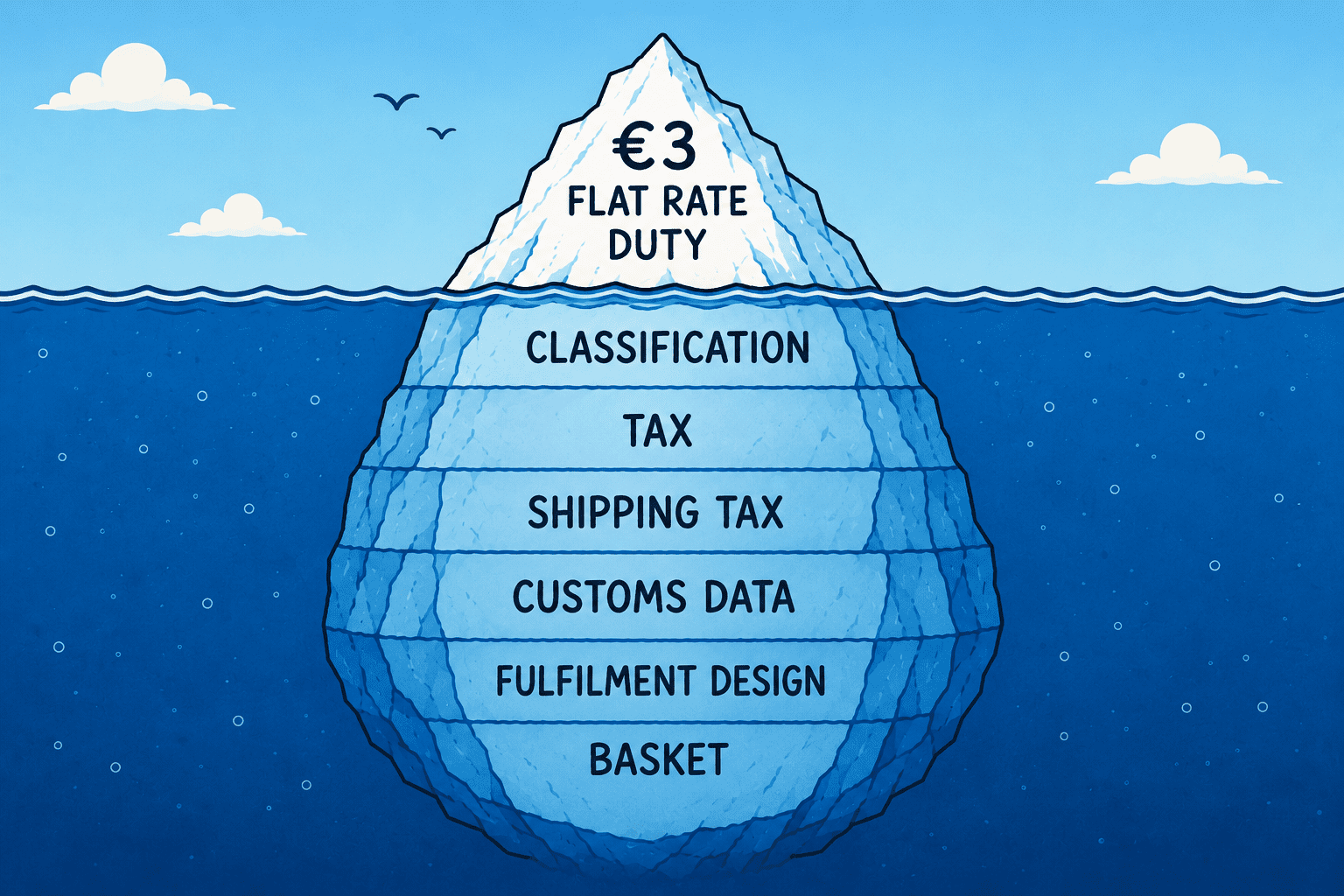
Flat Rate Iceberg

this is the last in a multi-post series… part I is available here, part II is available here and part III is here.


When the EU announced the new €3 flat rate customs duty for low-value imports, many merchants immediately focused on the obvious question:

“How much more will this cost us?”

It’s the wrong question – if you’re an ambitious eCommerce merchant. The better question is:

“How much more will it cost our competitors?”

Over the last few posts, we explored the uncertainty surrounding the new €3 duty. First, we examined the unanswered question at the centre of the reform: what exactly is the €3 charge applied against? That has now been answered with relatively little doubt (and, thankfully, our original interpretation was correct – phew…!)

Then we looked at the consequences of getting that answer wrong. Not from a compliance perspective (because nobody really worries about compliance, right..?), but from a commercial one. Incorrect assumptions can distort landed costs, inflate customer charges and create pricing disadvantages that are completely avoidable within the rules.

Finally, we demonstrated that the same basket of goods can legitimately produce different customs outcomes depending on how it is structured and declared.

That last point matters more than many merchants realise, because the new duty is not really a product problem – it is a data problem. When the Product data is incorrect, everything downstream is also incorrect. That includes Taxes, Duties and Customs Declarations.

Historically, many cross-border merchants could afford to treat customs classification as an administrative afterthought. A product description was entered, a shipping label was generated and the parcel moved.

The economics of that approach are changing as a result of these new regulations. And, like all regulation-driven innovation, merchants can choose to see this as an inconvenient and frustrating imposition or an opportunity to leverage the rules while competitors are struggling to come to terms with them (this is the philosophy we built ePAL on, as discussed in an interview with Kumar Dattatreyan).

From July 2026, customs classification, basket composition, declaration structure and fulfilment decisions will directly influence landed cost outcomes. Two merchants selling similar products at similar prices may end up producing very different customer experiences.

One customer sees a smooth checkout with predictable costs. Another sees unexpected charges, abandoned baskets or higher total prices. The products may be identical. The difference is intelligent and intentional operational design. This is where many businesses will discover that the challenge is larger than the €3 charge itself.

Most merchants do not have customs specialists reviewing every order. They do not have teams manually evaluating tariff classifications. They do not have people calculating different fulfilment scenarios in real time. And they certainly do not have staff checking whether one declaration approach produces a better outcome than another while remaining compliant.

At scale, that is impossible. The only practical answer is automation. Not automation that simply calculates tax (tax is irrelevant in this context and, in fact, for merchants expecting their Tax calculation plugins or service providers to ‘deal with this’… don’t hold your breath).

And it is not enough just automate identification of duty rates any more. The real opportunity presented to forward-thinking merchants by this new regulation is automation that understands and leverages the relationship between products, classifications, basket composition, fulfilment models and destination-country requirements.

In other words, automation that treats customs and tax as part of the checkout journey rather than as an afterthought that happens after payment. That is the opportunity ePAL was built for – the core of ePAL is a complex orchestration engine and this new regulation is just another orchestration for us… and so it should be for you.

While much of the market is still discussing the €3 duty as a new cost, we see it as an orchestration & optimisation challenge.

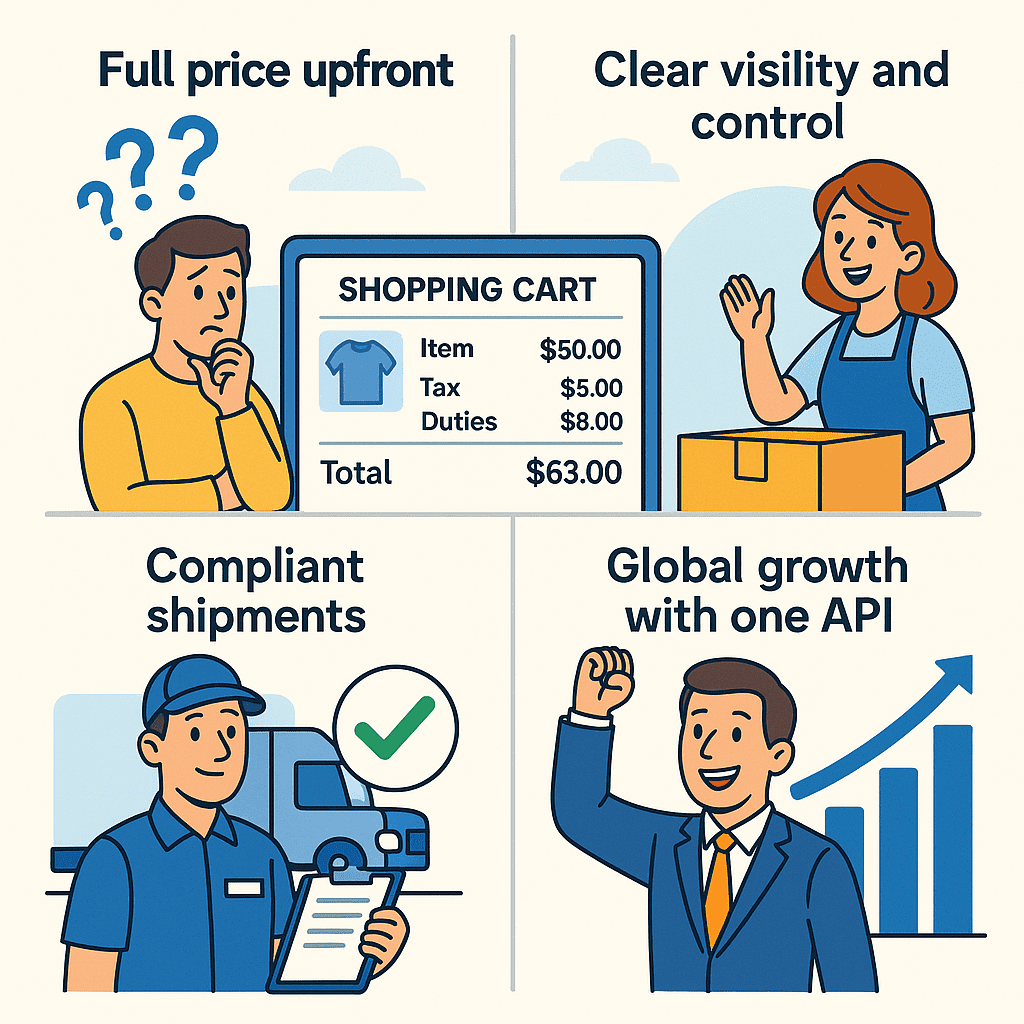
Merchants need visibility into the full landed cost outcome before an order is placed. They need systems capable of understanding how different products interact within a basket. They need compliant calculation of tax, duties, shipping taxes and destination-country requirements. And increasingly, they need technology capable of identifying opportunities that would be practically invisible to humans operating manually.

The reality is that the July 2026 reforms will not affect every merchant equally.

  • Some businesses will simply absorb higher costs.
  • Some will pass those costs to customers.
  • Some will discover that their existing processes are no longer competitive.

Others will adapt. They will build smarter checkout experiences, make better fulfilment decisions, understand their customs data more deeply. And they will turn what looks like a regulatory burden into a commercial advantage.

The €3 duty was introduced as a simplification measure.

Ironically, it may end up rewarding the merchants who understand complexity best.

That is exactly the problem ePAL was designed to solve.

Posted on 5 Comments

The €3 flat rate duty (pt.III): same basket, different outcome. No accident

In the first post in this series [The €3 flat rate duty and the important unanswered question (pt.1)], we asked a simple question:

What exactly is an “item”?

In the second [The €3 flat rate duty (pt.II)”], we asked another simple question:

What happens if you get it wrong?

Now we have something more useful than speculation: we have clarification from regulators (yes, we simply asked the Regulators and received some responses). However, as is often the case, the clarification answers the question… while simultaneously creating a more interesting one.

(if you want to skip ahead and ruin the suspense, part IV (conclusion) is here).


The short version

The €3 duty is not applied to the basket. It is applied to how the basket is declared.

Which means:

The same physical shipment of the same physical goods can produce different duty outcomes.

Let’s unpack that properly.

What the regulators said

Recent clarification from EU authorities provided a working definition of an “item”:

So far, so reasonable.

Then comes the part that matters:

And critically:

Customs systems treat each declaration line as a separate duty event

Separately, national authorities have indicated that:

That is the formal position.

Now translate that into the real world.

The official definition of “per item” is not what most people think

Most merchants will instinctively assume:

4 products = 4 items = €12

That is not how this works.

In practice, 4 products can be 1 item, 2 items, 3 items or 4 items… depending on how they are declared. The word “item” sounds physical. It isn’t. It is structural.

The declaration – not the basket – drives the outcome

This is where things get interesting.

You can have:

  • the same products
  • the same quantities
  • the same value

And still end up with:

  • different duty outcomes

Why?

Because the system doesn’t charge based on what you sold. It charges based on how that sale is represented in the customs declaration.

Generic basket = flat rate lines

This is not theoretical. It is a direct consequence of how the system works.

  • If goods are grouped into a single declaration line
    -> €3 total
  • If those same goods are split across multiple lines
    -> €3 per line

Same shipment. Different structure. Different result.

Take a basket containing 4 excellent and highly recommended books about Product Innovation:

  1. “Start with Why” by Simon Sinek
  2. “Be Less Zombie” by Elvin Turner
  3. “Zone to Win” by Geoffrey Moore
  4. “No rules rules” by Reed Hastings

Assume they all cost €10.

If they are listed as 4 separate product lines on the customs declaration, the duty will be €12. If they are listed as one declaration line, the duty will be €3.

Classification depth adds another layer of variability

It gets better (or worse, depending on your viewpoint!).

Depending on how the declaration is made (i.e. which import declaration ‘flow’ is used):

  • you may classify goods at:
    • HS6 level (broader grouping), or
    • HS10 or 11 level (more granular)

More granularity can mean:

  • more distinct “items”
  • more declaration lines
  • more €3 charges

And right now, this is not consistently applied across all flows.

Systems, not people, will decide most of this

In theory, this is about classification. In practice, it is about systems:

  • eCommerce platforms
  • middleware
  • shipping providers
  • customs brokers
  • declaration engines

Each of these can influence:

  • how items are grouped
  • how lines are created
  • how data is structured

Which means:

The duty outcome can be decided long before anyone consciously thinks about it or long after anyone has paid for it.

The uncomfortable bit

The regulation is trying to simplify low-value imports but what it actually introduces is a dependency on how goods are represented, not just what they are. That creates a new kind of inconsistency. Not legal inconsistency or classification inconsistency but structural inconsistency

Two valid declarations
-> for the same goods
-> can produce different results

This is not “gaming the system”

It is important to be clear about this. There is nothing “wrong” going on here. It’s exactly how the regulations are designed and published. Like us Product Managers(!), Regulators don’t worry too much about the “how” – their concern is the “what” and the “why”. As a result, nothing described here requires:

  • manipulation
  • optimisation tricks
  • bad intent

This happens simply because:

  • systems structure data differently
  • declarations are generated differently
  • classification depth varies

In other words:

Two merchants can get very different outcomes while both are doing everything “by the book”

Why this matters more than it looks

At €3, this may not seem like a big deal but the impact compounds:

  • multi-line baskets
  • high-volume merchants
  • automated fulfilment flows
  • VAT applied on top of duty

Now multiply that across thousands of shipments. Or, to be more precise, billions of shipments (given that the whole reason for introducing this new rule is the 5.8 billion – and climbing – low value consignments shipped into the EU last year).

Suddenly, this isn’t about €3 anymore. It is about:

  • margin erosion
  • pricing accuracy
  • customer trust
  • audit defensibility

So where does this leave us (or you, the merchant)?

Back to the original question from Part I:

What is an “item”?

We now have a better answer:

An “item” is not what you sell
It is how you describe what you sell on a customs declaration

And maybe you have no idea because you leave that to others…

Final thought

If you take one thing from this series, it should be this:

The problem is not the €3 charge
The problem is assuming it behaves in a simple, predictable way

Because it doesn’t and if you design your checkout, pricing, or fulfilment flows on that assumption, you are going to get surprised.

If Part I was about the question, and Part II was about the risk, then this is the reality:

Same basket. Different structure underneath. Different outcome.


If you want to find out more about how ePAL Global can help you not only prepare for the new cross-border reality but also to get ahead of it and optimise your product catalogue as well as your fulfilment and shipping flow, feel free to visit www.ePALGlobal.eu/landing if you are a WooCommerce user or www.ePALGlobal.com if you use a different platform or custom-developed web store.

Posted on 2 Comments

The €3 flat rate duty (pt.II): what happens when you get it wrong?

In part one of this series we asked about the new €3 “flat rate” EU Customs Duty for low value cross-border imports , we asked a simple question: what is the €3 flat rate duty actually calculated against? It sounds trivial on the surface, but as we explored, the answer is far from clear.

The previous post focused on the ambiguity at the heart of the rule. This one is about the consequences of that ambiguity, because once you move past the question of “€3 per what?”, a more important realisation appears. The €3 itself is only part of the problem. What happens after only makes it worse.

Since then, we engaged with Regulators to ask them what ‘categorisation’ they plan to use and the general response was: “We don’t know yet” (yes, that’s the Regulators). The clearest response we received was:

…the €3 will be charged “per position in the import customs declaration”.

Hmmm… not the most helpful when it comes to clarity – but at least it’s a starting point!

Same basket, different outcomes

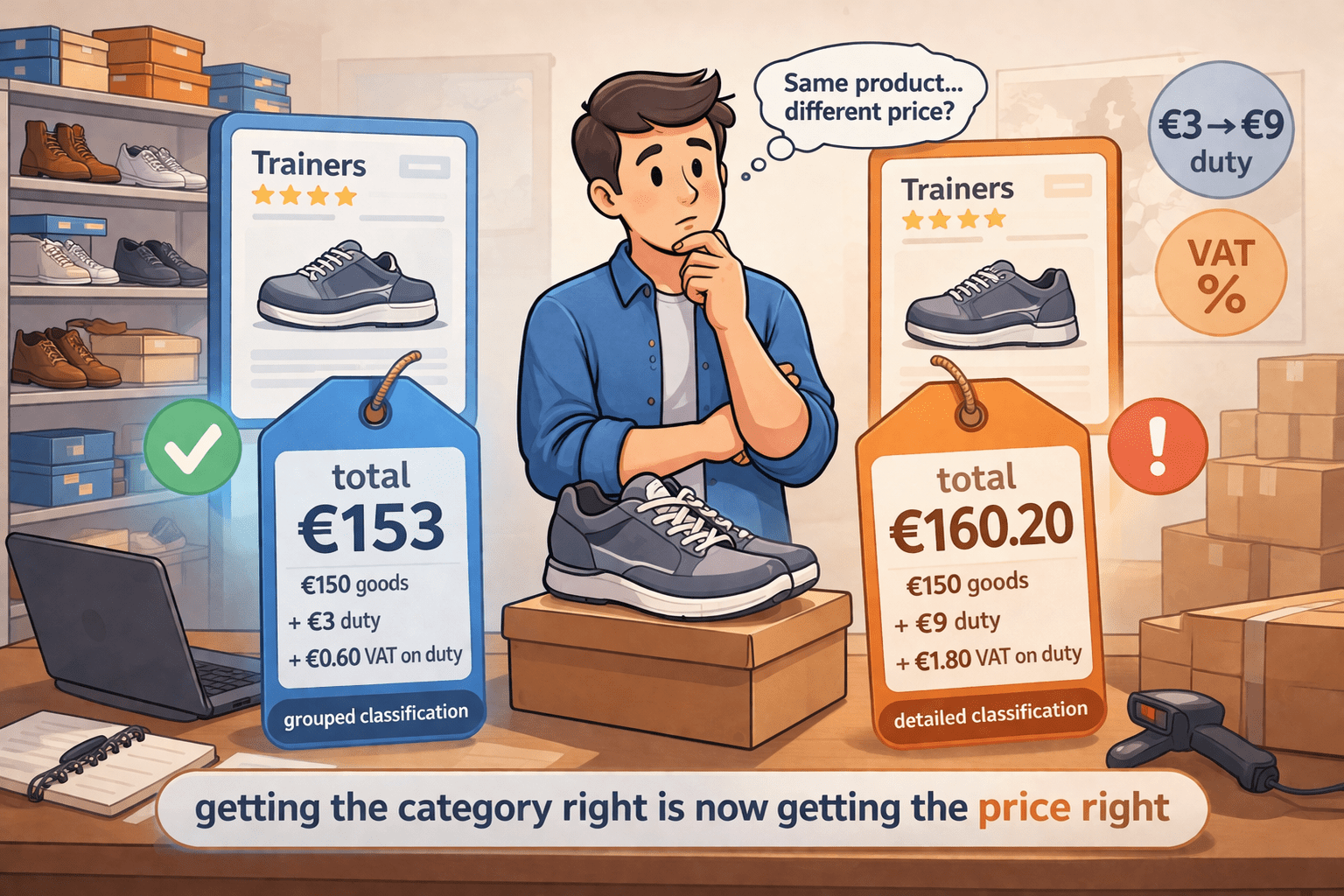
Let’s go back to the same example we used for illustration purposes in the previous post. A merchant sells three pairs of trainers made from different materials: leather, textile and plastic, each priced at €50. From a customer perspective, this is a simple, coherent basket with a total value of €150. There is nothing unusual or complex about it.

Cart with 3 types of trainers

From a customs perspective, however, things diverge quickly. Depending on how those products are classified and grouped, the €3 rule produces two very different outcomes. If treated as a single category, the duty is €3. If split into three distinct categories, the duty becomes €9.

It is the same basket, for the same customer, with the same intrinsic value. The only variable is how the products are described within the system. That was the problem outlined in Part 1. But the impact becomes even more pronounced (i.e. more expensive for your customers & more detrimental to your business) once you follow that difference through the rest of the calculation.

Duty does not stay contained

It would be convenient if duty were the end of the story – a small adjustment applied at the edge of the transaction. In reality, duty is an input into several other calculations and those calculations determine the final price that the customer actually sees (whether that is in the checkout or when the delivery arrives at the door accompanied by a demand for extra payment).

Once duty changes, everything built on top of it changes as well. VAT is recalculated, total landed cost shifts and the checkout price moves accordingly. What initially looks like a €3 versus €9 issue becomes more significant. Getting duty wrong does not stay contained. It spreads.

Wrong duty = wrong tax on duty

This is not a new concept. We have seen the same dynamic before in a different context, as discussed here:
https://imaginef1.shop/2025/11/27/not-all-products-are-created-equal/

In many import scenarios, VAT or Import Tax is calculated not only on the value of the goods and shipping but also on the duty itself. This creates a compounding effect. If the duty is incorrect, the VAT calculated on that duty will also be incorrect. If you unnecessarily calculate Customs Duty (flat rate or otherwise) too high, then you also add too much VAT – and you will most likely never know.

Applying this to the earlier example makes the point a bit more concrete. If the duty is €3 and VAT is applied at 20%, the VAT on duty is €0.60. If the duty is €9, the VAT on duty becomes €1.80. The difference in VAT alone is €1.20, entirely driven by how the €3 rule is interpreted. That’s on top of the potential €6 overcharging of “flat rate” duty.

When combined with the €6 difference in duty, the total variance at checkout becomes €7.20. That is not a rounding error. It is a visible price difference for the same goods, created purely by classification decisions. For a basket that is nominally €150, the “fully landed cost” will either be €153.60 or €160.80. That is a significant difference.

Where this becomes real

At this point, the discussion moves out of the world of tax logic and into the reality of commerce. Two merchants selling identical products can now present different final prices to the same customer, based solely on how they apply the rule.

The customer does not see tariff sub-headings or classification logic. They see one price that is lower and one that is higher – and they make a ‘where to buy‘ decision based on that. It does not require a large difference to influence behaviour. It simply needs to exist.

flat rate duty Post 2

That difference can affect which product appears first when the customer clicks ‘order by lowest price‘, which option feels more attractive and ultimately which merchant secures the sale. What began as a classification nuance becomes a direct input into revenue.

There is no safe error

It might be tempting to assume that there is a safer direction to lean in, perhaps by being conservative and charging more to avoid risk. In practice, both directions introduce problems.

Overcharging, by applying too many €3 duties, results in a higher checkout price. This reduces competitiveness and directly impacts conversion rates. Customers are unlikely to choose the more expensive option when alternatives exist.

Undercharging creates a different set of issues. If too few €3 duties are applied, the shortfall may be corrected later in the process, often at the point of delivery. This leads to additional charges, customer frustration and – in many cases – refused deliveries and returns.

There is no safe error. There are only different consequences, and both are potentially commercially damaging.

What the system encourages

Faced with this situation, merchants will behave rationally. They will optimise for lower checkout prices and higher conversion rates, because those are the metrics that drive their business.

In practice, this means simplifying classification where possible and grouping products at higher levels. This is not necessarily an attempt to avoid compliance. It is a response to the incentives created by the system itself.

The unintended outcome is difficult to ignore. The more precisely goods are classified, the more likely it is that additional €3 charges will be applied, increasing the final price. The system, as it stands, quietly rewards less granular classification.

That is not a stable or desirable equilibrium and it is difficult to believe this is the behaviour Regulators wanted to encourage.

What this means in practice

This is not a problem that can be solved with simple shortcuts. Approaches such as applying €3 per shipment, per SKU or per unit may appear convenient but they are not aligned with how customs defines goods. Each of these shortcuts introduces inaccuracies that surface either in pricing or in fulfilment.

Instead, merchants are left making decisions in an environment where the rules are not fully defined (yet, at least). They must determine how to classify their products, how to group them, and how to apply the €3 rule in a way that is both defensible and commercially viable. Consider that the poor merchant who sells three types of trainers might actually sell a dozen different forms of footwear with a dozen different classifications.

This is not a trivial exercise. It requires judgement, consistency and a willingness to revisit decisions as guidance evolves (or it requires ePAL..!)

What merchants should do now

Until clearer guidance emerges, the most practical approach is to focus on consistency and awareness rather than perfection. Merchants should be explicit about the level of classification they are using and apply their grouping logic consistently across transactions.

Perhaps most importantly, this should be treated as a pricing problem as much as a tax problem. The impact is ultimately visible at the point of purchase and that is where it matters most.

For merchants who have not already classified their products using Customs-specific classification, this must be the first port of call – even long before the duty classification rules are defined & published. No matter what they are, the rules will be based on standard Customs classification that already exists (that’s the one thing we learned from Regulators!).

Luckily, merchants can classify products to HS6 level using ePAL Global with no cost & no commitment.

Bringing it back to the core idea

In Part 1, the issue was uncertainty. In Part 2, the issue is consequence. The €3 rule was introduced as a simplification but in practice it has shifted complexity into classification, grouping, and interpretation. That complexity does not remain hidden in systems or documentation. It surfaces in the final price presented to the customer, where even small differences can influence behaviour and outcomes.

Getting the category right is no longer just about compliance. It is about getting the price right. And in a competitive environment, that is the only number the customer really sees.


If you want to find out more about how ePAL Global can help you not only prepare for the new cross-border reality but also to get ahead of it and optimise your product catalogue as well as your fulfilment and shipping flow, feel free to visit www.ePALGlobal.eu/landing if you are a WooCommerce user or www.ePALGlobal.com if you use a different platform or custom-developed web store.


Read on for part III in the series.

Posted on Leave a comment

Intrinsic Value: The €150 IOSS threshold explained (properly!).

In eCommerce, there is a particular phrase that sounds reassuring while doing very little real work: “The €150 IOSS threshold is simple”. It is usually said by someone who has not had a shipment stopped, a customer refuse delivery or a courier ask for money that nobody expected to pay.

The €150 threshold is viewed as a clean dividing line. Below it, life is easy. Above it, things get complicated. Unfortunately, this mental model is wrong in just enough ways to cause problems at scale.

Let’s dispel this ‘myth’ with an accurate and (hopefully) useful explanation – not theory or marketing. Just how the threshold actually behaves in the real world of cross-border eCommerce.

What the €150 threshold is supposed to do

At a policy level, the €150 threshold exists to reduce friction on low-value imports into the EU. If a consignment qualifies for IOSS:

  • VAT is collected at checkout
  • Customs duties do not apply
  • The parcel should clear customs without the buyer being asked for additional payment

This is the intent: reduce friction, improve predictability & keep low-value purchases moving. None of that is controversial. The problems start when the threshold is treated as a price tag, rather than what it really is: a valuation test performed using explicit rules set by Customs authorities

The first misunderstanding: €150 is not the checkout price

Merchants often assume the threshold is evaluated against:

  • The price shown to the customer, or
  • The amount charged to the card, or
  • The order total in the store currency

None of these are correct.

The IOSS threshold is assessed against something called intrinsic value, calculated:

  • In euro
  • Using customs rules
  • Using customs exchange rates
  • After removing certain taxes
  • Before adding certain other charges

This already tells you something important.

If your store does not explicitly calculate intrinsic value using the same rules as customs, then the €150 threshold is being guessed, not calculated.

What “intrinsic value” actually means in practice

Intrinsic value is the customs valuation of the goods themselves, excluding some things and including others.

In practical terms, that means:

  • The value of the goods only
  • Excluding transport and insurance, but only if they are shown & priced separately
  • Excluding any Tax that might already be included in the ‘source’ country
  • Calculated in euro
  • Using the official customs exchange rate, not your checkout FX

This is where many otherwise competent systems fall over. Merchants price for customers. Customs values for regulators. These two worlds are not aligned.

Currency: the silent breaker of assumptions

Most eCommerce systems use:

  • Live FX rates
  • PSP or card network conversions
  • Daily or even intraday pricing logic

Customs does not.

EU customs authorities publish monthly exchange rates that remain fixed for the entire period. These rates are authoritative for customs valuation and deliberately insulated from market volatility. The consequence is uncomfortable but unavoidable:

  • A basket that appears to be €149.50 at checkout may be €150.20 for customs purposes.

So what…? Well, it means that your basket is no longer eligible for streamlined IOSS treatment – but you will probably never know that because your order records show it as €149.50.

Nothing about the product changed. Nothing about the customer changed. Only the valuation framework changed: FX rates at checkout are different than FX rates published as much as a month ago and used by customs.

If the system evaluating IOSS eligibility does not use the official customs FX rate, the result is not “approximately correct”. It is simply wrong.


Tax removal before tax addition (yes, both happen)

Another common error is assuming the threshold test is performed on a price that already includes source-country taxes. It isn’t.

Where product prices include tax from the origin country, that tax must be removed before the intrinsic value is calculated. Only then is destination-country VAT applied for the purposes of calculating DDP (aka Fully Landed Cost). Note: Destination-country VAT is calculated separately for DDP (Fully Landed Cost) purposes and is not part of the intrinsic value test.

This matters because:

  • VAT rates differ by product
  • VAT rates differ by country
  • Mixed baskets compound the effect

Shipping: excluded, except when it isn’t

The formal definition of intrinsic value excludes shipping when it is separately stated.

That sounds simple until you encounter:

  • Free shipping models
  • Bundled pricing
  • Promotions where shipping is partially absorbed
  • Platforms that do not break shipping out cleanly
  • Mixed baskets where some products have shipping included in the price and others don’t

At that point, the question becomes not “is shipping excluded?” but “can shipping be cleanly excluded?”

If it cannot, customs authorities may treat part of that value as belonging to the goods themselves.

This is one of those areas where “probably OK” turns into “held at the border”.


The threshold is per consignment, not per product

Another persistent misconception is that multiple low-value items remain low-value when shipped together. They don’t. The €150 test applies to the entire consignment, not individual SKUs.

Two €80 items shipped together are not two IOSS-eligible products. They are one non-IOSS-eligible consignment.

This sounds obvious when stated plainly. It is surprisingly easy to miss when orders are built dynamically, split across fulfilment locations, or merged downstream by carriers.


Why “close enough” fails disproportionately

Many merchants adopt a pragmatic approach:

  • Assume eligibility below a comfortable buffer
  • Pad pricing slightly
  • Rely on carriers to resolve edge cases

This works until volume increases.

The failure mode of IOSS misclassification is asymmetric:

  • Ten correct orders go unnoticed
  • One incorrect order causes a visible delivery problem
  • The customer only remembers the failure

This is why merchants often believe they “mostly get it right” until the day they don’t and the cost lands all at once. In reality, merchants might not even know it’s a problem – the customer simply doesn’t buy again


The real cost of getting the threshold wrong

When an order is incorrectly treated as IOSS-eligible:

  • Customs duties may suddenly apply
  • VAT may be recalculated at import
  • Carriers add handling fees
  • Customers are asked to pay at the door
  • Deliveries are refused
  • Returns become complex or impossible
  • VAT reporting no longer matches reality

None of this shows up in conversion metrics. It shows up in support tickets, negative reviews, and quietly eroded trust.


Why merchants should not try to “manage” the threshold

The €150 threshold is not a pricing decision.
It is not a marketing lever.
It is not a UX choice.

It is a regulatory classification that must be evaluated using rules most checkout systems were never designed to handle.

Trying to manually align:

  • Live checkout FX
  • Fixed customs FX
  • Destination VAT rates
  • Mixed baskets
  • Shipping allocation
  • Consignment logic

…is not a matter of effort. It is a matter of architecture.

This is why spreadsheets, plugins and carrier calculators inevitably diverge.


The only workable model: separation with mediation

The practical solution is not to force checkout pricing to behave like customs valuation, or vice versa. Each serves a different purpose. The workable model is to allow both to operate as intended and introduce a system that can:

  • Perform the correct intrinsic value test internally
  • Using the correct customs valuation and FX logic
  • In real time
  • Before the customer ever sees a final price

At that point, the outcome is binary and defensible:

  • Either the consignment qualifies for IOSS
  • Or it does not and must follow a different path

There is no ambiguity and no post-delivery correction.


What “explained properly” really means

The €150 IOSS threshold is not complicated because regulators enjoy complexity.

It is complicated because it sits at the intersection of:

  • Tax law
  • Customs valuation
  • Currency policy
  • eCommerce pricing behaviour

Treat it as a number and it will betray you. Treat it as a process and it becomes predictable. That predictability is the real prize. When merchants can trust that every order has been classified correctly before it ships, the downstream chain stabilises. Fewer delays. Fewer refusals. Fewer arguments at the door.

The threshold itself does not become simpler – but the business impact does. That is the difference between knowing about the €150 limit and actually understanding it.

Posted on Leave a comment

Why selling into the EU feels harder than it should (and how ePAL makes it easy)

US Merchants can now sell to the EU just as easily

For most US merchants, selling into the EU doesn’t fail at checkout. Orders convert. Payments clear. Customers are happy – at least for a few days. The problems arrive later: whether at customs, with the carrier or at the customer’s front door.

From the US perspective, this feels unfair. You already sell domestically. Your checkout works. You calculate sales tax when required. You ship thousands of orders a month without drama. Europe has customers, credit cards, and couriers just like anywhere else… so why does selling there feel like stepping into a regulatory maze?

The answer is very simple and very fair (if frustrating): the EU expects correctness before checkout finishes, not explanations after delivery fails.

The EU Is Not One Market – Even If Platforms Pretend It Is

A common trap for US merchants is thinking of “the EU” the way you think of “the US”: One country. One tax logic. One unilateral framework with local variations. That mental model breaks immediately in Europe.

The EU is 27 countries with:

  • Different VAT rates and different Tax treatments for the same Products.
  • Different rules for taxing shipping.
  • Different enforcement standards at customs.

Many platforms still flatten this complexity into a single “EU VAT” setting. Often that means applying a standard VAT rate across the entire basket “to be safe.”

It feels cautious. It’s not. In reality, it means Merchants (or, more accurately, their platforms) often overcharge VAT, just to be safe. And over-calculating VAT on the Product (even just one Product in a basket) is compounded because it also results in over-charging VAT on the Shipping and, if Customs Duties are levied, also over-charging VAT on the Customs Duties.

Put simply, over-collecting VAT makes your prices uncompetitive. Worse, it introduces downstream errors when Customs recalculates everything using the correct product-specific rules. Even if your platform over-charges VAT (to be safe), Customs authorities might recalculate a lower amount on import and the delay – never mind the associated handling charges – often kills the deal for the Customer.


VAT in the EU Is Product-Specific, Not Basket-Wide

In the US, sales tax usually applies at checkout based on jurisdiction, with limited product differentiation. In the EU, VAT is fundamentally different. Some products are standard-rated. Some are reduced-rated. Some are zero-rated. Books, children’s clothing, medical and safety equipment often fall into the latter categories. But not in every EU country. Electronics rarely do.

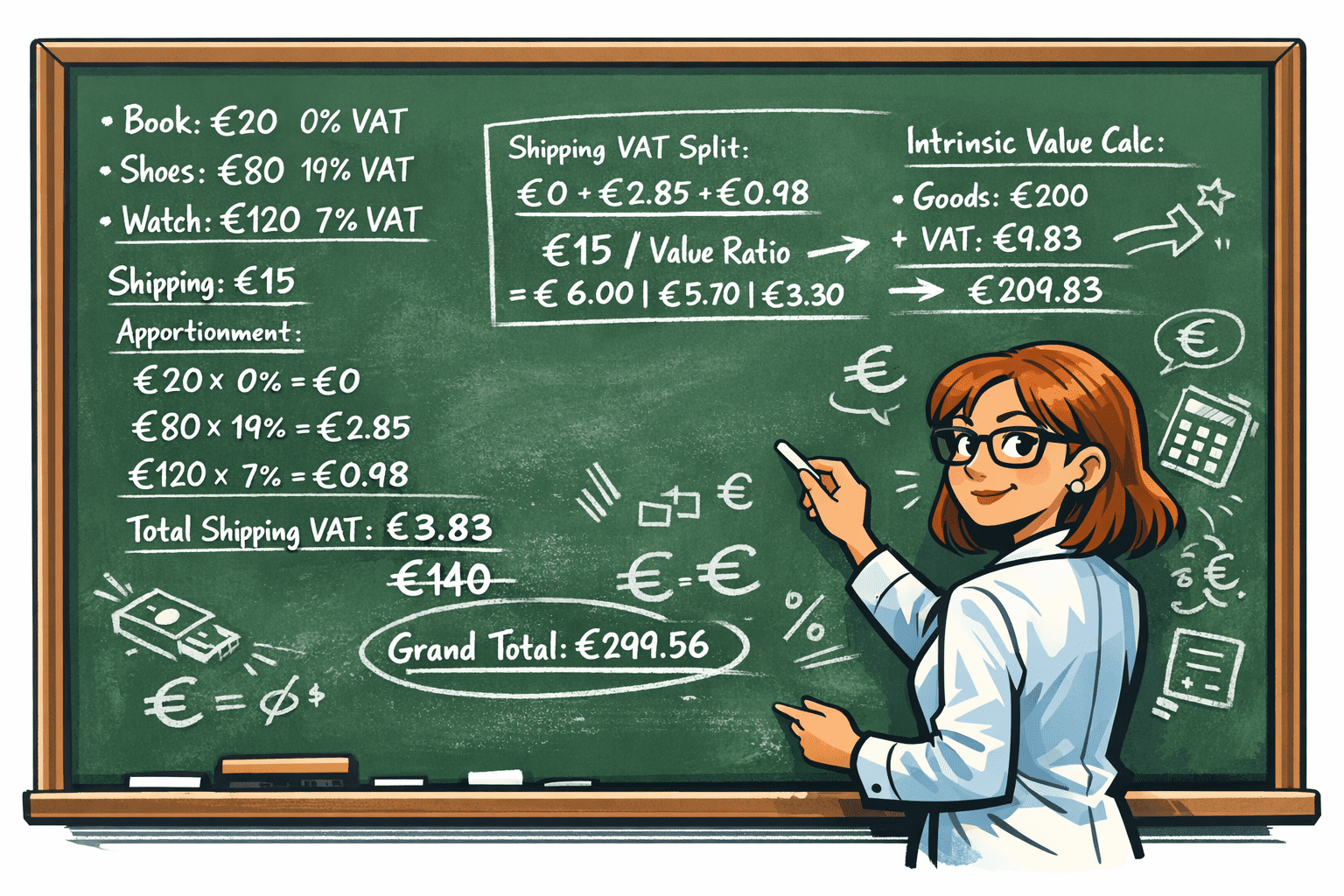
When a customer buys a mixed basket – say a book, a hoodie, and a gadget – the EU expects three separate VAT treatments, not one blended rate calculated on the total (which is the way it’s done in the US). For a US merchant, imagine if every Product had a different Sales Tax applied, and if Tax on Shipping had to be calculated using the exact ratio of the various Sales Taxes vs the Product prices.

Its easy to see how this can become complicated and convoluted. As a result, most systems do not handle this kind of complexity. They pick one rate and apply it to everything. Its usually the ‘Standard Rate’ (which is always the highest rate for the buyer’s Country). Alternatively, they leave it to you – the Merchant – to specify the Tax rates to apply. And, of course, Merchants will probably apply the Standard Rate (to be safe), even when it is unnecessary.

That single shortcut inflates prices, miscalculates VAT on shipping, and poisons every calculation that follows, including refunds and customs declarations.

Mixed Baskets Are the Norm, Not an Edge Case

US merchants are often told that “edge cases” cause international failures. But mixed baskets are not edge cases. They are normal shopping behavior. And when customers buy multiple items – which they do – EU customs does not see a cart. It sees individual line items, each with its own classification, VAT rate, duty logic, and threshold behavior.

Treating a basket as a single object is convenient for checkout UX but disastrous for compliance. This is where many otherwise competent setups quietly fail – and nobody notices until the package arrives at the point of import.

Shipping Is Taxable – and the Rules Change by Country

Shipping in the EU is not tax-neutral. VAT will apply to shipping for packages sent to EU customers (including from EU to EU, because tax rates are different in each country), and the rate depends on:

  • The destination country
  • The VAT rates of the products in the basket
  • Country-specific allocation rules

Some countries require shipping VAT to be allocated proportionally across line items. Others default to the highest VAT rate in the basket. Some allow reduced or zero VAT on shipping under specific conditions. Most US merchants never see this complexity, except maybe when a return, audit or customs recalculation exposes it. Incorrect shipping VAT breaks refund logic and creates mismatches between what was collected, what was declared and what customs expects to see.

The €150 Threshold Is Not as Simple as You Might Think

The EU’s €150 threshold for simplified import treatment (via IOSS) looks deceptively simple. Below €150, things are easy. Above it, things get complicated. Except the threshold is not based on your checkout total. It is based on intrinsic value, calculated:

  • In euros.
  • Using official EU customs exchange rates (not live FX).
  • Excluding origin-country taxes.
  • Including destination VAT.

A $160 order priced with live FX may look compliant at checkout because it’s under €150 using the Fx rates “today” and still fail at customs when recalculated using the EU’s fixed monthly rate (published weeks ago and unchanged since). From the merchant’s perspective, nothing changed. From Customs’ perspective, everything did. That mismatch is where shipments stop, Customs Duties are applied, along with Tax on those Duties and no doubt some delay, handling fees or both.

HS6 Classification Is Not Enough

Many US merchants rely on HS6 product codes because that is what global trade documentation historically required. In cross-border commerce, HS6 is often insufficient. Many products diverge at HS10 or HS11. Germany, for example, enforces this strictly. Two products that look identical commercially may carry different duty rates once fully classified.

Applying a generic HS6 code is not “close enough.” It is wrong and wrong classifications compound errors across duty calculation, VAT on duty, and shipping VAT.

Why Carriers End Up Taking the Blame

When checkout calculations and Customs recalculations disagree, carriers become the messenger. They are required to collect additional charges or refuse to deliver the goods. They are left to explain discrepancies to confused customers. They are associated with delivery failures.

But carriers do not create tax liability. They expose it. The root problem is almost always upstream data that was incomplete or incorrect before the parcel ever shipped.

“We’ll Fix It at Import” Is Not a Strategy

Many merchants assume that mistakes can be corrected later. They can’t That’s not “fixing” the problem, that’s outsourcing the problem – to your customer.

Once checkout completes:

  • The customer expectation is set
  • The payment is captured
  • Fulfillment is triggered

Fixing numbers after that point is escalation, not correction.

Refused deliveries, returns, destroyed parcels, support tickets and lost customers all stem from the same mistake: deferring accuracy.

This Is the Gap  ePAL Global Was Built to Close

ePAL is not a checkout widget and not a tax estimator. It is a behind-the-scenes orchestration layer that ensures the price shown to the customer is the price customs will accept.

ePAL works by treating every basket as line-level truth:

  • Correct HS10/HS11 classification per product for the buyer’s Country.
  • Correct VAT rate per product, per destination.
  • Correct shipping VAT allocation per country, according to country-specific rules where applicable.
  • Correct Duty calculation per line and correct, rule-based calculation of Tax on Duty.
  • Correct IOSS vs DDP routing using official EU FX

All of this is calculated before checkout completes. No estimates. No flattening. No surprises.

So What Changes for US Merchants

With ePAL in place:

  • EU prices are correct, audit-friendly and predictable.
  • Customs no longer has to recalculate import Tax & Duty.
  • Customers stop refusing deliveries with additional Fees applied.
  • Returns and support costs fall.
  • Margins stop leaking through “just in case” Standard Rate buffers.
  • Compliance stops being a guessing game and becomes a stable commercial input.

That predictability is what allows US merchants to sell into the EU – not cautiously or occasionally but consistently and confidently.

The Opportunity for US Sellers

Cross-border commerce does not fail because Europe is complicated. It fails because accuracy is deferred or because platforms swap ‘estimated’ for ‘calculated’.

ePAL exists to remove that deferral – to make EU selling boring, deterministic, trustworthy, scalable.

Duty Delivery Paid (DDP) or Fully Landed Cost is not a premium feature. It is what Customers expect and are willing to pay for and once it is calculated correctly (quietly, upstream) everything else gets easier. The end result is that US Merchants can confidently sell into the EU without the hassle of calculating EU-specific prices or EU-specific Shipping on EU-specific web stores. One store can serve the US and EU with just one ePAL integration.

Posted on 1 Comment

Not all products are created equal. If you can’t get your Tax right, what about the Tax on your Tax?

There is a moment in cross-border sales where your customer meets your Maths. It’s the moment your shopper looks at the price in the checkout and decides whether to click Buy. That moment is shaped not just by your product, your brand or your delivery promise – but also by something more subtle and far more expensive when it goes wrong: the correct VAT rate.

Most shoppers never think about VAT. Many sellers don’t either, until they realise their platform has been “playing it safe” by assuming Standard Rate VAT for every product in every basket. That might feel sensible (because it means you never undercalculate tax… and who wants to do that, right?) but for many merchants it is the accounting equivalent of carrying a life jacket for a trip through the desert.

Not all products are created equal. Not all VAT rates are either.

Most products attract Standard Rate VAT, yes. But a surprising number don’t.

Most Merchants sell mostly Standard Rate products, for sure. But many Merchants sell at least some reduced rate goods and some Merchants sell nothing but reduced rate goods.

These are just some of the categories in which Products regularly attract zero VAT or reduced VAT:

  • Medical equipment
  • Safety equipment
  • Books, manuals and printed learning materials
  • Children’s clothing
  • Medicines and pharmaceuticals
  • Many food & drink items
  • Baby products
  • Animal feed
  • And many more

These categories aren’t niche or exotic. They represent tens of millions of sales every year. However, many platforms, plugins and marketplaces don’t know how to identify the correct VAT rates automatically… so they default everything to Standard Rate. And Standard Rate is the highest VAT rate in the Customer’s country.

Mixed baskets make the problem bigger

Shoppers don’t always buy in neat, regulation-friendly patterns. They buy a book and a toy for a child’s birthday. Or a first-aid kit and a warning triangle for the car. Or protein powder and pet food.

Each category can have a different VAT rate but many sellers, storefronts and SaaS platforms can’t identify the right rate per product so they choose the one thing they can identify – Standard Rate is an easy lookup table.

It feels “safe”. It is anything but, because when VAT is wrong, it isn’t wrong by a little. It is wrong at every level of the calculation.

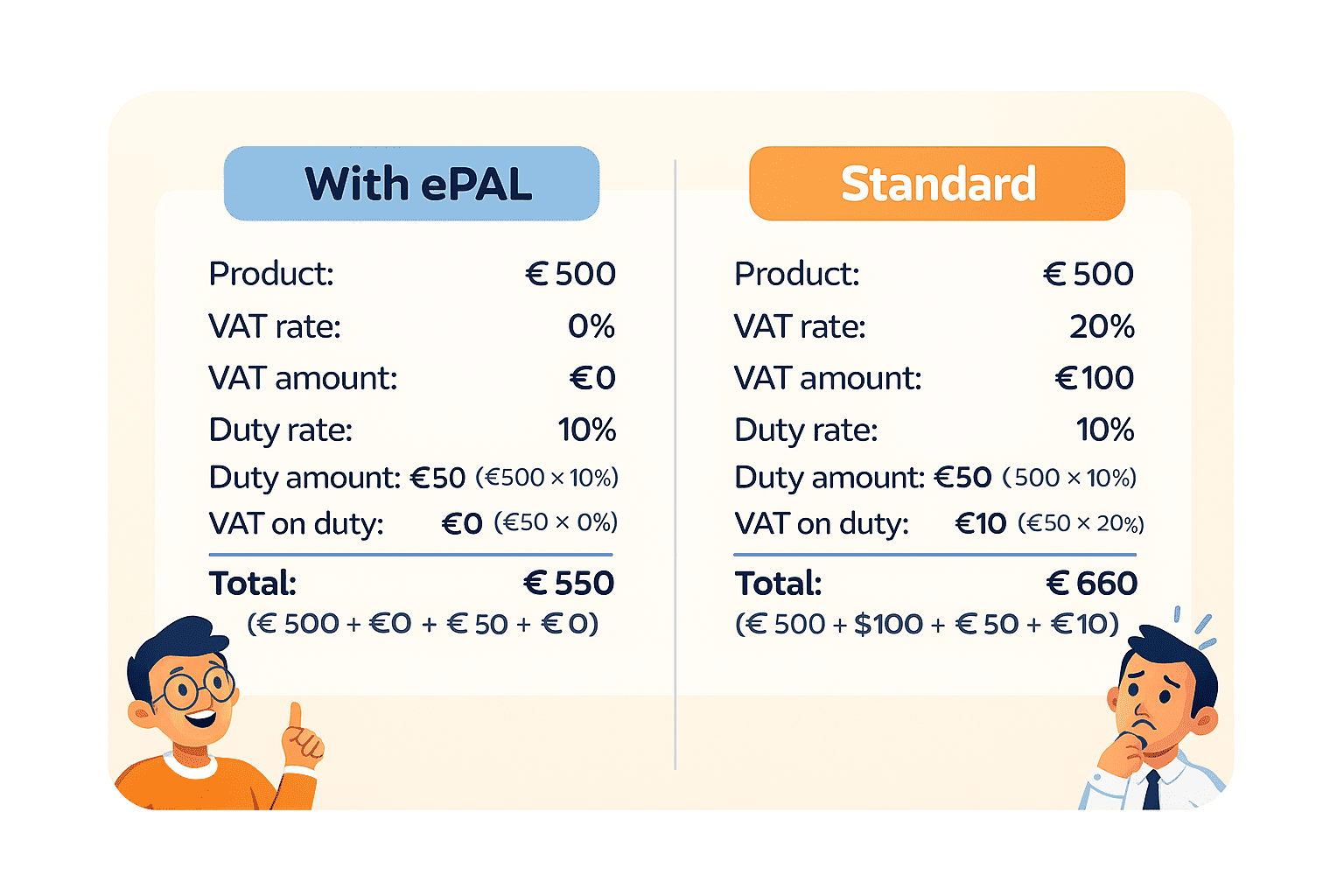
Consider a product that should be zero-rated, like a medical item. If your platform assumes a 20 percent Standard VAT rate, here is what happens:

  1. Your product VAT jumps from €0 to €100 (on a €500 item).
  2. Your basket suddenly becomes more expensive than competitors.
  3. Your customer buys elsewhere and you never even know they visited.

But the pain doesn’t stop there. Once the item passes the VAT stage, we land in the world of Customs Duty. Many consignments attract Customs Duty on import (and this will be extended to all incoming consignments by the end of 2026). Customs Duty rates are specific to each Product and they are completely unrelated to the VAT rate of the product.

A book might attract zero duty while a textile item might attract 6 percent. A medical device might attract 0 percent while a sports accessory sits at 8 percent. The Duty Amount is basically the Product price (without Tax) multiplied by the Duty Rate.

And then comes VAT on Duty (yes, tax on tax)

Even after the Customs Duty amount is calculated correctly, there’s a second layer that most merchants forget until it bites them: VAT is charged on the Customs Duty amount.

So when a platform assumes Standard Rate VAT, two things happen:

  1. VAT on the product is too high.
  2. VAT on the Duty is also too high.

The mistake compounds. Wrong VAT rate chosen = wrong VAT amount on the Product but also = wrong VAT amount on Duty too. And it is always ‘wrong’ by being higher than it needs to be, never lower.

Take our earlier example and assume the product has 10% Customs Duty:

  • Product: €500
  • Correct VAT rate: 0%
  • Duty: €50
  • VAT on Duty at correct rate: €0

Total correct cost: €550

But if your platform just assumes Standard VAT (in this case 20%, which is about average across EU countries):

  • Product: €500
  • Assumed VAT rate: 20%
  • VAT on product: €100
  • Duty (at 10%): €50
  • VAT on Duty (at the same assumed 20%): €10

Total wrong cost: €660

That is a €110 difference created entirely by incorrect identification of the VAT rate. Not by the law. Not by the carrier. Not by Customs. By the platform thinking it was being “cautious”.

Your customer doesn’t care about VAT logic. They care about price.

A shopper comparing two websites does not think:

“Ah yes, Website A has mis-applied Standard Rate VAT to a zero-rated product and compounded the error through the wrong VAT on Customs Duty”

They think:

“Why is this one €110 more expensive?”


Click. They buy where the price is right instead.

And the worst part? They think the difference is you. Not your tax engine, not your plugin, not your platform. You.

The brand takes the blame. The margin takes the hit. The customer takes their business elsewhere – maybe forever.

This is exactly the kind of invisible friction ePAL removes

ePAL identifies the correct VAT rate per product, in real time, using classification logic that understands product categories, destination country rules and mixed-basket apportionment.

It calculates:

  • the correct VAT per item
  • the correct Customs Duty
  • the correct VAT on Duty
  • the correct total cost

All before your customer clicks Buy.

No guessing. No overcharging. No buffer margins to “stay safe”. When your price is accurate, your customer trusts it. When your VAT is correct, your basket is competitive. When your landed cost is precise, your brand wins.

This is what ePAL was built for: cross-border compliance with a click.

Visit www.ePALGlobal.com for more info

Posted on Leave a comment

The cross-border Watch case & why small errors can create big headaches

ePAL blog - the legend of the 50c cross border Watch case

There’s a comforting lie that runs through eCommerce: the idea that little mistakes only create little problems. Rounding differences. A VAT rate that’s “close enough.” A classification you’re pretty sure matches the product. A tiny component that couldn’t possibly matter.

Cross-border commerce loves to punish that optimism.

So today we’ll talk about one of the best examples in the wild: the €0.50 wristwatch part. An object so unremarkable that merchants assume it lives in the administrative no man’s land marked “surely nothing important happens here.” Yet in regulatory reality it sits on a razor edge of Customs rules, value-based thresholds, HS code logic and tax-on-duty interactions that can turn a half-euro piece of metal into a difference of many euros for your customer.

This is exactly the kind of case where most providers struggle and where ePAL was designed to shine – because cross-border commerce isn’t broken by dramatic events. It’s broken by tiny misclassifications that create big consequences.

A miniature object with oversized regulatory impact

Let’s say you sell wristwatches. One of your customers damaged the case of their watch and needs a replacement case. It weighs almost nothing. It costs nearly nothing. Even shipping would be trivial. It feels like the kind of harmless SKU you’d toss into a padded envelope as a gesture of goodwill and forget about.

But the Customs system doesn’t. This watch case is one of the legendary oddities of cross-border eCommerce.

In most countries a full wristwatch has a straightforward duty rate. But a watch case shipped alone has its own classification rules and its own peculiar calculation for determining duty. In some jurisdictions the logic is something like “apply a €0.50 duty only when €0.50 is less than a specific percentage of the declared value and simultaneously more than a different percentage raten of the same declared value.” (wait… what?).

This is the kind of rule a human will never remember and most tax engines won’t handle, so the merchant confidently applies the duty rate used for complete watches. The carrier takes that data at face value. Customs receives it, recalculates it and decides the shipment is misdeclared. Suddenly a €0.50 part trips a data integrity failure and an additional couple of Euro in Duties which, in turn triggers a Carrier handling charge, a very pissed off customer and a keener Customs eye on future shipments.

Why this matters more than the price tag

The reason the humble watch case becomes a problem is the same reason so many cross-border shipments fail. The system doesn’t care about your intuition. It doesn’t care that the value is small or that the customer isn’t expecting a formal import process. It cares that the rules didn’t match the data.

And when that happens your tiny replacement part can cause:

  • customs holds because the declaration “looks wrong”
  • recalculated duties that exceed the value of the item
  • additional VAT on those recalculated duties
  • handling surcharges for manual processing
  • a refusal by the buyer who doesn’t want to pay unexpected charges
  • a return or destruction of the goods
  • a customer support complaint about “fake charges” or “scammy delivery”
  • a negative review based on a product that never even made it to the wrist

You don’t lose money on the SKU itself. You lose money on the mess it creates.

In other words: cross-border failure rarely happens at the €500 luxury item. It happens at the €0.50 edge case, because that’s where most systems break.

This isn’t hypothetical. The ecosystem of blogs and customer forums already discuss similar examples of unexpected regulatory treatment, from classification-driven tax miscalculations to tax-on-shipping distortions and mixed-basket anomalies

That’s why ePAL was created. One click (or one API call) solves all of these problems.

To find out more, see www.ePALGlobal.com

Posted on Leave a comment

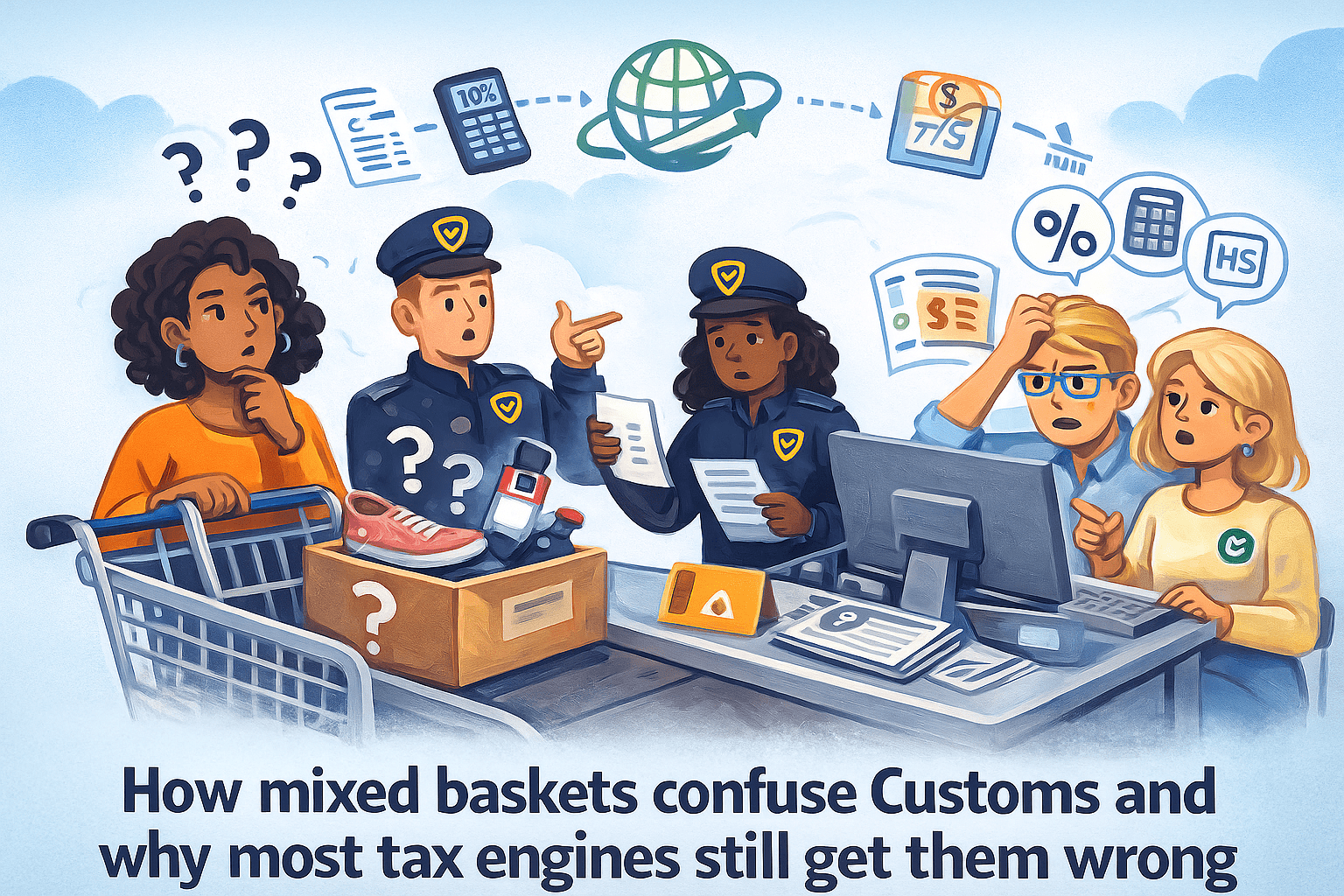
How mixed baskets confuse Customs and why most tax engines still get them wrong

How mixed baskets confuse Customs and why most tax engines still get them wrong

There is something charmingly simple about a single product checkout. One SKU, one VAT rate, one duty rate, one HS code, one shipping rule. It is the regulatory equivalent of a calm Sunday morning. Everything is where it should be and nothing surprises anyone.

Unfortunately most customers do not shop that way. They buy a pair of shoes, a notebook, a skincare product and a bottle of vitamins in one go. They mix standard rate with reduced rate. They blend products that are zero rated with products that trigger excise. They add an item that is IOSS eligible next to an item that pushes the order across the €150 threshold. They create a basket that makes perfect sense to them and absolutely no sense to the tax engine behind the scenes.

It is exactly here, in the cheerful chaos of mixed baskets, that cross border eCommerce usually breaks. Quietly.

Why mixed baskets are where compliance goes to die

Most legacy tax engines and plugin calculators were built for a simpler world. They take a shortcut. They work out a single VAT rate, apply it to the whole basket, guess at a duty rate if needed, apply a shipping tax rule (usually the wrong one) and then call it a day. It is clean, simple and almost always wrong when the basket is ‘complex’.

Mixed baskets demand a different mindset. Customs does not care about convenience. Customs cares about what each item is made of, what rate applies to it specifically and how the shipping cost must be allocated on a per line basis. A leather shoe is not a notebook. A notebook is not a vitamin supplement. A supplement is not a face cream. And Customs is not amused when systems pretend otherwise.

This is not an edge case. This is the real world. And it is where most deployments of IOSS, DDP and any kind of fully landed cost calculation begin to wobble.

The five silent failure points inside every mixed basket

There are five places where mixed baskets go wrong long before a parcel reaches a border.

1. VAT rates that refuse to cooperate

One product is standard rate. One is reduced rate. One is zero rated. The customer sees a simple basket. The tax authorities expect to see three separate tax regimes. eCommerce checkouts are supposed to know this. Most don’t. They choose a single VAT rate. It is the wrong choice and it affects shipping VAT, refunds and IOSS eligibility. And it almost always makes the basket price higher than it should be – never lower.

2. Shipping tax apportionment rules that vary by country and product mix

In Germany shipping tax must be allocated proportionally across each line in the basket. In France shipping often defaults to the highest VAT rate in the basket. In other jurisdictions shipping might attract no tax at all. In jurisdictions that don’t specify exact rules, they often state shippers must use a “reasonable” method of apportionment (whatever ‘reasonable’ might mean). Mixed baskets can create a variety of apportionment patterns in a single checkout. Most tax engines simply ignore this and charge VAT at the standard rate. This almost always results in more VAT than required being charged to the consumer – never less.

3. IOSS eligibility that changes product by product

IOSS is a scheme for consignments below €150 excluding shipping and tax / VAT (meaning, any tax that’s in the product before it sails across a border). One item might be eligible. Another might push the basket over the threshold. The difference at borderline basket values can depend on the destination VAT rate and official EU FX. A mixed basket can qualify for IOSS at checkout and fail the moment Customs recalculates the value using FX rates from 3 weeks earlier. Many tax engines do not test basket eligibility using the rules Customs actually use.

4. Duty calculation that needs HS10 or HS11, not HS6

HS6 is not enough for accurate duty. Many products diverge at the tenth or eleventh digit. Mixed baskets often contain items that look similar but fall into different classifications. If a system applies a generic HS6 rate to everything it introduces errors that compound when shipping VAT and IOSS validation are layered on top. Even if the 10th or 11th digit don’t affect the Duty rate, some countries insist on them being included in the data and declarations because they use them for statistical analysis of imported goods. If not present, the consignment can trigger an inspection. Many systems only allow for a single HS code to be used and that’s usually the (common) HS6 code instead of the country-specific HS10 or HS11.

5. Refund logic that falls apart when shipping VAT was wrong in the first place

When customers return part of a mixed basket the merchant must refund tax on the returned item and sometimes tax on shipping associated with that item. If the original shipping VAT was miscalculated or misallocated the refund becomes unsynchronised with the declarations submitted to Customs. This creates audit risk and mismatched financial records.

None of these issues surface when a buyer purchases a single product. They only appear when baskets behave like baskets. Which is to say: they appear most of the time.

Why most tax engines struggle with this

Mixed baskets require line-level (i.e. product-level) precision, country specific rules and a detailed understanding of how taxes, duties and shipping costs interact. They also require a valuation engine that understands the strange but very real world of tax on duties and tax on shipping with product-level apportionment rules and the official threshold logic that Customs applies, whether merchants like it or not.

Legacy engines and plugin calculators usually operate at basket level, not line level. They rely on static mappings, simplified assumptions, incomplete classification, generic VAT rules and shipping logic that does not reflect what happens at the border. They cannot apply ten different rules to five different line items in real time because they were never built to.

Merchants rarely see the error. They only see the outcome: delayed consignments, rejected packages, customers who refuse to pay extra charges and carriers who send back invoices with the phrase “incorrect declaration” printed politely but firmly at the top.

This is exactly the problem ePAL was created to solve

Mixed baskets are not unusual. They are the norm. They are also the reason ePAL treats every basket as a set of independent line items with their own rules, their own classifications and their own tax logic. And then treats the collection of items (i.e. the basket) as another item with it’s own set of rules.

Here is what ePAL does that most others do not.

1. Each product is classified separately using HS10 or HS11.

No approximations. No “close enough matches”. No relying on HS6 when Customs requires HS10. Each product receives a precise classification before any tax or duty logic is applied.

2. VAT is calculated per line at the correct product rate

If a basket contains four VAT rates, ePAL applies four VAT rates. It does not flatten them into one. It does not guess. It does not round. It calculates accurately.

3. Shipping VAT apportionment follows the rules of the destination country

If the country uses proportional allocation, ePAL applies it. If the country uses “highest rate in the basket”, ePAL applies that. If the country does not have any specified rules, ePAL does what is “reasonable” (and the Merchant is therefore protected by ePAL’s reasonableness test). If the country has exceptions for certain product categories, those exceptions are applied too. Line by line. And then at the basket level.

4. IOSS eligibility is tested using the official EU customs FX rate

This prevents the classic “looks like €149.99 at checkout but is €150.07 at the official EU rate” error that breaks shipments. ePAL runs the test correctly and silently and identifies the basket as IOSS or DDP as required so the Merchant can easily see which shipping flow to use. And then ePAL facilitates creation of the correct documentation (because, of course, they’re different!).

5. Duties are calculated per line using the correct base value

Some items attract duty only above thresholds. Others attract excise. Others trigger flat fees. Some require tax on duty. Some items oddly have more than one Customs Duty (Crispbread and Watch Casings are our favourite test products). ePAL handles all of it, per line item, in milliseconds.

6. Refund logic remains consistent because the original calculations were correct

When a customer returns item two from a six item basket, both the tax on the item and any associated shipping VAT can be refunded correctly. This keeps the merchant’s financial and Customs records in sync.

Mixed baskets are cross border eCommerce in its natural state

Customers mix products. Regulations mix rules. Customs mixes tax, duty and shipping logic. The only party that should not be mixing anything is the merchant. Mixed baskets defeat most systems because they were designed for simplicity, not reality. ePAL was designed for reality.

The world now expects clarity at checkout. It expects “no surprise costs at delivery”. It expects taxes and duties to be correct and complete. That level of confidence is not built on guesswork. It is built on understanding that every item in a basket carries its own regulatory truth.

Mixed baskets are complex but they do not have to be confusing. That is what ePAL fixes, quietly, line by line, long before a parcel ever leaves the warehouse.

Visit www.ePALGlobal.com for more info

Posted on Leave a comment

Why IOSS vs DDP Is Still Breaking Cross-Border Commerce and How ePAL Fixes It

ioss-v-ddp-with-epal.png

Why IOSS vs DDP Is Still Breaking Cross-Border Commerce and How ePAL Fixes It

Cross-border eCommerce has a reputation problem. Not because the products are bad or the merchants are untrustworthy, but because the systems behind the purchase are still stuck in a world where borders are physical, data travels slowly and tax authorities assume merchants have the free time and emotional resilience of a Vulcan tax accountant with an obsessive love of rules, regulations and reporting.

The infographic here – IOSS vs DDP – looks charming. Two tidy columns, friendly characters, neat speech bubbles. But beneath that cheerful exterior is the uncomfortable truth: today’s cross-border tax frameworks leave merchants navigating two entirely different worlds, and neither of them was designed with modern eCommerce in mind.

Let’s break it down.

Column 1: IOSS – Lovely in Theory, Limited in Reality

The IOSS (Import One-Stop Shop) scheme was introduced by the EU to simplify life for merchants selling low-value goods (€150 or below). On paper, it’s elegant:

  • Merchant calculates VAT at checkout.
  • Merchant reports & pays that VAT monthly via a single IOSS return.
  • No customs duties apply, because IOSS is strictly for low-value goods.

Simple. Predictable. Clean.

The result? A friction-free customer experience if and only if the order:

  1. Is €150 or below (excluding shipping)
  2. Ships from outside the EU to a consumer in the EU
  3. Contains products that don’t attract duties
  4. Follows the IOSS rules perfectly at every step – including the carrier’s side

That’s a very tight circle. And it can often exclude a significant portion of the Merchant’s baskets – everything with a basket total above €150.

The moment the basket creeps over €150, or one product triggers a duty (e.g. Excise), or a country requires additional classification digits (hello Germany), the IOSS flow collapses. The merchant has to switch to DDP or DAP, the carrier applies different rules (and probably higher rates) and the buyer gets an invoice they weren’t expecting.

Cue frustration, confusion, and the now-familiar “I ordered a €20 item and they tried to charge me €32 at the door” review.

IOSS is not the villain — it’s simply not capable of handling the rich, messy diversity of real-world cross-border commerce.

Column 2: DDP – The Grown Up Flow With Its Own Set of Nightmares

Delivered Duty Paid (DDP) is the serious sibling. The “we’ll take care of everything” option. Here, the merchant:

  • Calculates taxes and duties at checkout.
  • Ensures those amounts are actually sent to customs via the carrier, broker, or importer.
  • Handles every compliance, declaration, and classification step required for import.

In DDP, the customer is protected from nasty surprises. The price they saw online really is the price they pay. But DDP has one giant problem: you must get every detail right.

To calculate the correct fully landed cost, a merchant (or their platform) needs to know:

  • Country-specific VAT rates (at both ‘ship from’ and ‘ship to’ countries)
  • Country-specific ‘tax on shipping’ rules
  • Product-specific HS10 or HS11 classification
  • Country-specific duty rates for every HS10 or HS11 code
  • Duty thresholds
  • Excise rules
  • Flat fees, tariff quotas, special charges
  • Whether taxes compound on duties (yes, in many countries they do)

And just to spice things up, the rules change if:

  • The item is leather instead of synthetic,
  • The basket contains multiple items with mixed VAT rates,
  • One product is low-value and another isn’t,
  • The product is considered a “sports article” in one country and “fashion” in another,
  • A country requires classification digits beyond HS10,
  • Or the carrier applies its own interpretation of the regulations.

In other words: DDP requires perfect data, different players have different rules on what ‘perfect’ means and most merchants absolutely do not have perfect data.

That’s how even the most well-intentioned DDP flows end up producing packages stopped at customs, mis-declared duties, delays, surcharges, return-to-sender events, and the most miserable of Merchant-Customer outcomes: a Courier arriving with a bill instead of a delivery.

The Real Problem: Merchants Shouldn’t Have to Live in This Complexity

Merchants want to sell products, delight customers, and grow their business.

They didn’t sign up to become:

  • amateur customs experts,
  • part-time tariff researchers,
  • HS code detectives, or
  • tax reconciliation specialists.

Yet today, cross-border eCommerce forces merchants into this role.
Not because they want it — because without doing it, they risk:

  • Abandoned carts
  • Refused deliveries
  • Unexpected charges
  • Returned parcels
  • Support tickets
  • Margin erosion
  • Negative reviews
  • Financial penalties

And worst of all: customers losing trust in the brand.

Back to the picture

The two columns demonstrate a harsh truth: IOSS is too limited; DDP is too complicated. Most merchants sell baskets for both and many fall through the cracks between the two systems.

This Is Exactly the Gap ePAL Fills

ePAL was created for the world that exists now – not the regulatory frameworks of 2015 or the carrier workflows of 2008.

Where IOSS is limited and DDP is overwhelming, ePAL makes the entire journey simple, accurate, and compliant.

Here’s how ePAL fixes the mess:

1. Product classification becomes automatic

No more guessing HS codes.
No more spreadsheets.
No more “HS6 looks close enough.”

ePAL identifies the correct classification per product, per country.

2. Tax & duty calculation becomes instant and precise

Every VAT rate.
Every duty threshold.
Every shipping-tax rule.
Every country-specific nuance.
Every detail handled in milliseconds.

Whether it’s IOSS-eligible or DDP-required, the system automatically applies the correct logic.

3. The customer sees the real price at checkout

No estimates.
No small print.
No surprises later.

Just honest, compliant, fully landed pricing.

4. Declarations, data, and handovers are correct by default

The carrier gets the right data.
Customs gets the right declarations.
Shipments clear faster.
Successful deliveries increase.
Returns or rejections fall.
Support tickets evaporate.

5. Everyone in the chain benefits

  • Merchants increase conversions and reduce returns.
  • Buyers regain trust in cross-border shopping.
  • Carriers eliminate failed deliveries and awkward doorstep tax disputes.
  • Platforms gain cross-border capability without building tax engines.

The Big Picture: Trust Is the Real Currency of Cross-Border Commerce

Whether you use IOSS or DDP, the underlying truth is the same:

What customers want is certainty.

They want to know:

  • what they’re paying,
  • why they’re paying it,
  • and that the parcel will arrive without drama.

That’s not a tax problem. It’s a trust problem.
And trust is exactly what ePAL restores.

IOSS alone can’t do it.
DDP alone can’t do it.
Merchants alone definitely can’t do it.

But a unified, intelligent, behind-the-scenes engine built for today’s cross-border reality (aka ePAL)..? That can.

For more, see www.ePALGlobal.com

Posted on Leave a comment

When the Cost of Cross-Border Compliance in eCommerce Is Your Competitive Advantage

If you’re selling from outside the EU or expanding your reach within it, you’ve probably already discovered that “going cross-border” means more than just adding a few shipping zones to your checkout. It means mastering a patchwork of tax regimes, customs codes, trade thresholds, product classifications, safety standards, and the invisible monster: compliance.

The EU is one of the most lucrative online markets in the world but it’s also one of the most heavily regulated. For many merchants, that combination feels like standing at the gates of opportunity holding a suitcase full of paperwork and facing off against a battalion of bureaucrats.

The invisible barrier to growth

Here’s the irony: the same rules designed to make European trade fair and predictable can make it feel unpredictable to the merchants trying to comply. A single SKU can trigger five different tax and duty outcomes depending on its composition, packaging, and declared purpose. A €149 basket might pass smoothly through IOSS, while a €151 basket of the same goods triggers full customs duties, additional VAT and handling charges that turn profit margins into rounding errors.

Behind each transaction lies a maze of logic:

  • HS codes that decide what a product is for regulatory purposes. And you might be amazed by the result.
  • Tariff & Duty schedules that decide how much duty to charge and whether it’s based on weight, value, or category.
  • Country-specific tax rules that might apply standard, reduced, or zero rates (sometimes all three within the same basket).
  • Shipping tax apportionment that requires tax on delivery to be recalculated line-by-line depending on product type.
  • Customs thresholds that change at €150, or sometimes don’t, depending on how “intrinsic value” is defined.

Multiply this across 27 EU member states and thousands of products and it’s easy to see why merchants hesitate. The complexity isn’t theoretical – it directly affects pricing, profit and customer experience.

The false economy of “just get it through”

Most small and mid-sized sellers take a pragmatic shortcut: estimate, approximate, and hope for the best. Maybe the plugin you use adds VAT automatically and maybe it’s at the “Standard Rate” (which means you’ll never undercharge VAT… but also means you might often overcharge and that makes your prices uncompetitive).

It works… until it doesn’t. Your “close enough” becomes expensive the moment a package hits customs with missing data or incorrect tax, duty or classification. Then comes the chain reaction:

  • Parcels delayed (even if they’re eventually release with no additional costs)
  • Or maybe simply refused by your Customer if there are additional charges.
  • Angry customers who thought they’d already paid in full.
  • Unexpected invoices for duties or taxes you didn’t collect from your Customer.
  • Refunds that no longer match your original tax declarations.
  • Support tickets and return costs that quietly eat your margin.

Compliance mistakes don’t scale: they compound.
And the more successful you become, the more they cost.

The paradox of compliance

The smartest merchants already know that compliance isn’t a checkbox; it’s a commercial function. Done properly, it builds trust, protects margins, and turns cross-border operations from guesswork into growth.

Because when you understand the real landed cost of your goods, you can do more than just stay legal. You can price confidently, advertise truthfully, and deliver predictably. And you can often find that your goods are cheaper than your competitors’ simply because they’re complaint.

That clarity isn’t just good governance. It’s good marketing. Think of it like this:

  • Transparency is the new loyalty program.
    Shoppers who know exactly what they’ll pay are far more likely to complete checkout and to come back. Conversely, if your Customer gets a shock at delivery, you may never even hear about it – or from them – again.
  • Speed is the new discount.
    Consignments with correct data clear customs faster. That means earlier deliveries, fewer exceptions and lower carrier penalties.
  • Predictability is the new growth lever.
    When your costs are stable, your pricing and promotions can be too. You’re no longer buffering your margins to cover uncertainty.

In short: what looks like a regulatory burden is, in fact, a strategic advantage if you can make it predictable.

Predictability: the currency of trust

To achieve that predictability, you need precision. And precision in the EU means understanding how taxes and duties interact in ways that aren’t obvious to the naked spreadsheet.

For instance:

  • In Germany, VAT on shipping must be proportionally distributed across each product in a basket, based on its tax rate.
  • In France, shipping might default to the highest VAT rate in the basket.
  • In Ireland, a book shipped with a toy can shift the whole consignment’s tax treatment.

Those differences sound small until you scale up — then they’re the difference between a 22% margin and a 9% one.

Most systems don’t catch this level of nuance. They aren’t built to. They handle single products, not mixed consignments; simple duties, not layered taxes-on-taxes. But regulators are looking. Customs data checks are increasingly automated. A missing 11th digit in a product’s classification code can stop a shipment cold at the German border, even though it doesn’t affect the Tax or Duties.

Merchants don’t want to be customs experts. Shoppers don’t want to read footnotes. Yet somewhere in between, someone has to get the calculations right.

The moment compliance becomes competitive

Here’s where the opportunity flips. Imagine being the seller who can say (with confidence) “No surprise costs at delivery.” Imagine showing the full, accurate, compliant price before checkout, broken out item-by-item, tax-by-duty. Imagine your customer never having to wonder whether “import fees may apply.” That’s not just compliance. That’s customer experience.

And it’s exactly where ePAL Global gives merchants their edge.

From compliance cost to commercial clarity

ePAL was built for the mess behind the maths – for multi-product consignments, tax-on-duty calculations, tariff rules and Shipping VAT apportionment that most systems skip. It maps product classifications, identifies the right HS10 or HS11 codes for each destination, retrieves the correct duty, tax, and excise rates, and then calculates the true fully landed cost… all in real time during Checkout.

It’s not about estimates; it’s about precision. So instead of guessing how customs will treat your products, you know. Instead of buffering your prices “just in case,” you can price with confidence. Instead of losing orders to cart abandonment, you can convert with transparency.

The result: the price your customer sees is the price they pay.
No extra invoices. No stranded parcels. No fine print.

What that means for your business

For merchants expanding into the EU, predictability changes everything:

  • Pricing accuracy means fewer margin surprises.
  • Declared compliance means faster customs clearance.
  • Transparent checkout means higher trust and conversion.
  • Reduced support overhead means more bandwidth for growth.

And for established exporters, it means being able to operate cross-border without building a compliance department or hiring a customs broker for every product category.

It’s compliance-as-a-service, in the truest sense, delivered through a single API or plugin that slots directly into your existing checkout.

The numbers that matter

With ePAL Global, compliance isn’t a cost sink – it’s a fixed, predictable value:

  • 1.5% of cross-border baskets for eCommerce merchants.
  • €999 per year for importers and exporters.

That’s it. No hidden duties, no sliding-scale brokerage, no post-delivery surprises.

When you can quantify your compliance cost, you can treat it like any other line of business: predictable, measurable, and optimisable.

The bigger picture

The future of cross-border eCommerce belongs to the merchants who treat compliance not as a defensive shield, but as an offensive strategy – a differentiator based on transparency and trust.

In an era where customers expect clarity, regulators demand accuracy and competitors are just one click away, the ability to promise “no surprises” isn’t just good ethics, it’s good business.

That’s the world ePAL Global was built for: a world where merchants can expand confidently, sell compliantly, and deliver seamlessly across every border, every basket, every time.

ePAL Global: turning the cost of compliance into your competitive advantage for eCommerce merchants, importers and exporters. No surprises. No uncertainty. Just clarity… delivered.

For more, see www.ePALGlobal.com