Posted on 5 Comments

The €3 flat rate duty (pt.III): same basket, different outcome. No accident

In the first post in this series [The €3 flat rate duty and the important unanswered question (pt.1)], we asked a simple question:

What exactly is an “item”?

In the second [The €3 flat rate duty (pt.II)”], we asked another simple question:

What happens if you get it wrong?

Now we have something more useful than speculation: we have clarification from regulators (yes, we simply asked the Regulators and received some responses). However, as is often the case, the clarification answers the question… while simultaneously creating a more interesting one.

(if you want to skip ahead and ruin the suspense, part IV (conclusion) is here).


The short version

The €3 duty is not applied to the basket. It is applied to how the basket is declared.

Which means:

The same physical shipment of the same physical goods can produce different duty outcomes.

Let’s unpack that properly.

What the regulators said

Recent clarification from EU authorities provided a working definition of an “item”:

So far, so reasonable.

Then comes the part that matters:

And critically:

Customs systems treat each declaration line as a separate duty event

Separately, national authorities have indicated that:

That is the formal position.

Now translate that into the real world.

The official definition of “per item” is not what most people think

Most merchants will instinctively assume:

4 products = 4 items = €12

That is not how this works.

In practice, 4 products can be 1 item, 2 items, 3 items or 4 items… depending on how they are declared. The word “item” sounds physical. It isn’t. It is structural.

The declaration – not the basket – drives the outcome

This is where things get interesting.

You can have:

  • the same products
  • the same quantities
  • the same value

And still end up with:

  • different duty outcomes

Why?

Because the system doesn’t charge based on what you sold. It charges based on how that sale is represented in the customs declaration.

Generic basket = flat rate lines

This is not theoretical. It is a direct consequence of how the system works.

  • If goods are grouped into a single declaration line
    -> €3 total
  • If those same goods are split across multiple lines
    -> €3 per line

Same shipment. Different structure. Different result.

Take a basket containing 4 excellent and highly recommended books about Product Innovation:

  1. “Start with Why” by Simon Sinek
  2. “Be Less Zombie” by Elvin Turner
  3. “Zone to Win” by Geoffrey Moore
  4. “No rules rules” by Reed Hastings

Assume they all cost €10.

If they are listed as 4 separate product lines on the customs declaration, the duty will be €12. If they are listed as one declaration line, the duty will be €3.

Classification depth adds another layer of variability

It gets better (or worse, depending on your viewpoint!).

Depending on how the declaration is made (i.e. which import declaration ‘flow’ is used):

  • you may classify goods at:
    • HS6 level (broader grouping), or
    • HS10 or 11 level (more granular)

More granularity can mean:

  • more distinct “items”
  • more declaration lines
  • more €3 charges

And right now, this is not consistently applied across all flows.

Systems, not people, will decide most of this

In theory, this is about classification. In practice, it is about systems:

  • eCommerce platforms
  • middleware
  • shipping providers
  • customs brokers
  • declaration engines

Each of these can influence:

  • how items are grouped
  • how lines are created
  • how data is structured

Which means:

The duty outcome can be decided long before anyone consciously thinks about it or long after anyone has paid for it.

The uncomfortable bit

The regulation is trying to simplify low-value imports but what it actually introduces is a dependency on how goods are represented, not just what they are. That creates a new kind of inconsistency. Not legal inconsistency or classification inconsistency but structural inconsistency

Two valid declarations
-> for the same goods
-> can produce different results

This is not “gaming the system”

It is important to be clear about this. There is nothing “wrong” going on here. It’s exactly how the regulations are designed and published. Like us Product Managers(!), Regulators don’t worry too much about the “how” – their concern is the “what” and the “why”. As a result, nothing described here requires:

  • manipulation
  • optimisation tricks
  • bad intent

This happens simply because:

  • systems structure data differently
  • declarations are generated differently
  • classification depth varies

In other words:

Two merchants can get very different outcomes while both are doing everything “by the book”

Why this matters more than it looks

At €3, this may not seem like a big deal but the impact compounds:

  • multi-line baskets
  • high-volume merchants
  • automated fulfilment flows
  • VAT applied on top of duty

Now multiply that across thousands of shipments. Or, to be more precise, billions of shipments (given that the whole reason for introducing this new rule is the 5.8 billion – and climbing – low value consignments shipped into the EU last year).

Suddenly, this isn’t about €3 anymore. It is about:

  • margin erosion
  • pricing accuracy
  • customer trust
  • audit defensibility

So where does this leave us (or you, the merchant)?

Back to the original question from Part I:

What is an “item”?

We now have a better answer:

An “item” is not what you sell
It is how you describe what you sell on a customs declaration

And maybe you have no idea because you leave that to others…

Final thought

If you take one thing from this series, it should be this:

The problem is not the €3 charge
The problem is assuming it behaves in a simple, predictable way

Because it doesn’t and if you design your checkout, pricing, or fulfilment flows on that assumption, you are going to get surprised.

If Part I was about the question, and Part II was about the risk, then this is the reality:

Same basket. Different structure underneath. Different outcome.


If you want to find out more about how ePAL Global can help you not only prepare for the new cross-border reality but also to get ahead of it and optimise your product catalogue as well as your fulfilment and shipping flow, feel free to visit www.ePALGlobal.eu/landing if you are a WooCommerce user or www.ePALGlobal.com if you use a different platform or custom-developed web store.
Posted on 1 Comment

Not all products are created equal. If you can’t get your Tax right, what about the Tax on your Tax?

There is a moment in cross-border sales where your customer meets your Maths. It’s the moment your shopper looks at the price in the checkout and decides whether to click Buy. That moment is shaped not just by your product, your brand or your delivery promise – but also by something more subtle and far more expensive when it goes wrong: the correct VAT rate.

Most shoppers never think about VAT. Many sellers don’t either, until they realise their platform has been “playing it safe” by assuming Standard Rate VAT for every product in every basket. That might feel sensible (because it means you never undercalculate tax… and who wants to do that, right?) but for many merchants it is the accounting equivalent of carrying a life jacket for a trip through the desert.

Not all products are created equal. Not all VAT rates are either.

Most products attract Standard Rate VAT, yes. But a surprising number don’t.

Most Merchants sell mostly Standard Rate products, for sure. But many Merchants sell at least some reduced rate goods and some Merchants sell nothing but reduced rate goods.

These are just some of the categories in which Products regularly attract zero VAT or reduced VAT:

  • Medical equipment
  • Safety equipment
  • Books, manuals and printed learning materials
  • Children’s clothing
  • Medicines and pharmaceuticals
  • Many food & drink items
  • Baby products
  • Animal feed
  • And many more

These categories aren’t niche or exotic. They represent tens of millions of sales every year. However, many platforms, plugins and marketplaces don’t know how to identify the correct VAT rates automatically… so they default everything to Standard Rate. And Standard Rate is the highest VAT rate in the Customer’s country.

Mixed baskets make the problem bigger

Shoppers don’t always buy in neat, regulation-friendly patterns. They buy a book and a toy for a child’s birthday. Or a first-aid kit and a warning triangle for the car. Or protein powder and pet food.

Each category can have a different VAT rate but many sellers, storefronts and SaaS platforms can’t identify the right rate per product so they choose the one thing they can identify – Standard Rate is an easy lookup table.

It feels “safe”. It is anything but, because when VAT is wrong, it isn’t wrong by a little. It is wrong at every level of the calculation.

Consider a product that should be zero-rated, like a medical item. If your platform assumes a 20 percent Standard VAT rate, here is what happens:

  1. Your product VAT jumps from €0 to €100 (on a €500 item).
  2. Your basket suddenly becomes more expensive than competitors.
  3. Your customer buys elsewhere and you never even know they visited.

But the pain doesn’t stop there. Once the item passes the VAT stage, we land in the world of Customs Duty. Many consignments attract Customs Duty on import (and this will be extended to all incoming consignments by the end of 2026). Customs Duty rates are specific to each Product and they are completely unrelated to the VAT rate of the product.

A book might attract zero duty while a textile item might attract 6 percent. A medical device might attract 0 percent while a sports accessory sits at 8 percent. The Duty Amount is basically the Product price (without Tax) multiplied by the Duty Rate.

And then comes VAT on Duty (yes, tax on tax)

Even after the Customs Duty amount is calculated correctly, there’s a second layer that most merchants forget until it bites them: VAT is charged on the Customs Duty amount.

So when a platform assumes Standard Rate VAT, two things happen:

  1. VAT on the product is too high.
  2. VAT on the Duty is also too high.

The mistake compounds. Wrong VAT rate chosen = wrong VAT amount on the Product but also = wrong VAT amount on Duty too. And it is always ‘wrong’ by being higher than it needs to be, never lower.

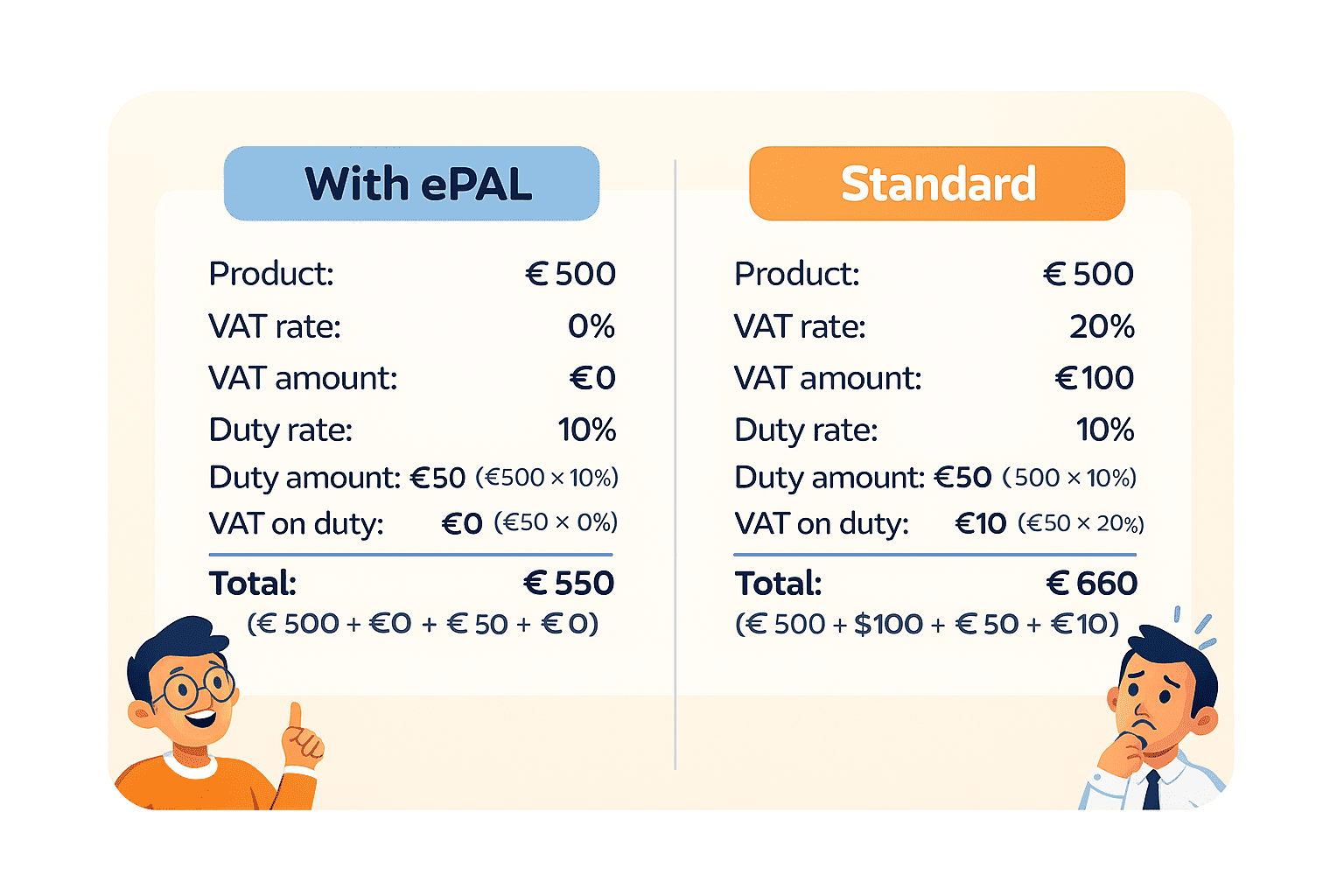
Take our earlier example and assume the product has 10% Customs Duty:

  • Product: €500
  • Correct VAT rate: 0%
  • Duty: €50
  • VAT on Duty at correct rate: €0

Total correct cost: €550

But if your platform just assumes Standard VAT (in this case 20%, which is about average across EU countries):

  • Product: €500
  • Assumed VAT rate: 20%
  • VAT on product: €100
  • Duty (at 10%): €50
  • VAT on Duty (at the same assumed 20%): €10

Total wrong cost: €660

That is a €110 difference created entirely by incorrect identification of the VAT rate. Not by the law. Not by the carrier. Not by Customs. By the platform thinking it was being “cautious”.

Your customer doesn’t care about VAT logic. They care about price.

A shopper comparing two websites does not think:

“Ah yes, Website A has mis-applied Standard Rate VAT to a zero-rated product and compounded the error through the wrong VAT on Customs Duty”

They think:

“Why is this one €110 more expensive?”


Click. They buy where the price is right instead.

And the worst part? They think the difference is you. Not your tax engine, not your plugin, not your platform. You.

The brand takes the blame. The margin takes the hit. The customer takes their business elsewhere – maybe forever.

This is exactly the kind of invisible friction ePAL removes

ePAL identifies the correct VAT rate per product, in real time, using classification logic that understands product categories, destination country rules and mixed-basket apportionment.

It calculates:

  • the correct VAT per item
  • the correct Customs Duty
  • the correct VAT on Duty
  • the correct total cost

All before your customer clicks Buy.

No guessing. No overcharging. No buffer margins to “stay safe”. When your price is accurate, your customer trusts it. When your VAT is correct, your basket is competitive. When your landed cost is precise, your brand wins.

This is what ePAL was built for: cross-border compliance with a click.

Visit www.ePALGlobal.com for more info

Posted on Leave a comment

The cross-border Watch case & why small errors can create big headaches

ePAL blog - the legend of the 50c cross border Watch case

There’s a comforting lie that runs through eCommerce: the idea that little mistakes only create little problems. Rounding differences. A VAT rate that’s “close enough.” A classification you’re pretty sure matches the product. A tiny component that couldn’t possibly matter.

Cross-border commerce loves to punish that optimism.

So today we’ll talk about one of the best examples in the wild: the €0.50 wristwatch part. An object so unremarkable that merchants assume it lives in the administrative no man’s land marked “surely nothing important happens here.” Yet in regulatory reality it sits on a razor edge of Customs rules, value-based thresholds, HS code logic and tax-on-duty interactions that can turn a half-euro piece of metal into a difference of many euros for your customer.

This is exactly the kind of case where most providers struggle and where ePAL was designed to shine – because cross-border commerce isn’t broken by dramatic events. It’s broken by tiny misclassifications that create big consequences.

A miniature object with oversized regulatory impact

Let’s say you sell wristwatches. One of your customers damaged the case of their watch and needs a replacement case. It weighs almost nothing. It costs nearly nothing. Even shipping would be trivial. It feels like the kind of harmless SKU you’d toss into a padded envelope as a gesture of goodwill and forget about.

But the Customs system doesn’t. This watch case is one of the legendary oddities of cross-border eCommerce.

In most countries a full wristwatch has a straightforward duty rate. But a watch case shipped alone has its own classification rules and its own peculiar calculation for determining duty. In some jurisdictions the logic is something like “apply a €0.50 duty only when €0.50 is less than a specific percentage of the declared value and simultaneously more than a different percentage raten of the same declared value.” (wait… what?).

This is the kind of rule a human will never remember and most tax engines won’t handle, so the merchant confidently applies the duty rate used for complete watches. The carrier takes that data at face value. Customs receives it, recalculates it and decides the shipment is misdeclared. Suddenly a €0.50 part trips a data integrity failure and an additional couple of Euro in Duties which, in turn triggers a Carrier handling charge, a very pissed off customer and a keener Customs eye on future shipments.

Why this matters more than the price tag

The reason the humble watch case becomes a problem is the same reason so many cross-border shipments fail. The system doesn’t care about your intuition. It doesn’t care that the value is small or that the customer isn’t expecting a formal import process. It cares that the rules didn’t match the data.

And when that happens your tiny replacement part can cause:

  • customs holds because the declaration “looks wrong”
  • recalculated duties that exceed the value of the item
  • additional VAT on those recalculated duties
  • handling surcharges for manual processing
  • a refusal by the buyer who doesn’t want to pay unexpected charges
  • a return or destruction of the goods
  • a customer support complaint about “fake charges” or “scammy delivery”
  • a negative review based on a product that never even made it to the wrist

You don’t lose money on the SKU itself. You lose money on the mess it creates.

In other words: cross-border failure rarely happens at the €500 luxury item. It happens at the €0.50 edge case, because that’s where most systems break.

This isn’t hypothetical. The ecosystem of blogs and customer forums already discuss similar examples of unexpected regulatory treatment, from classification-driven tax miscalculations to tax-on-shipping distortions and mixed-basket anomalies

That’s why ePAL was created. One click (or one API call) solves all of these problems.

To find out more, see www.ePALGlobal.com

Posted on Leave a comment

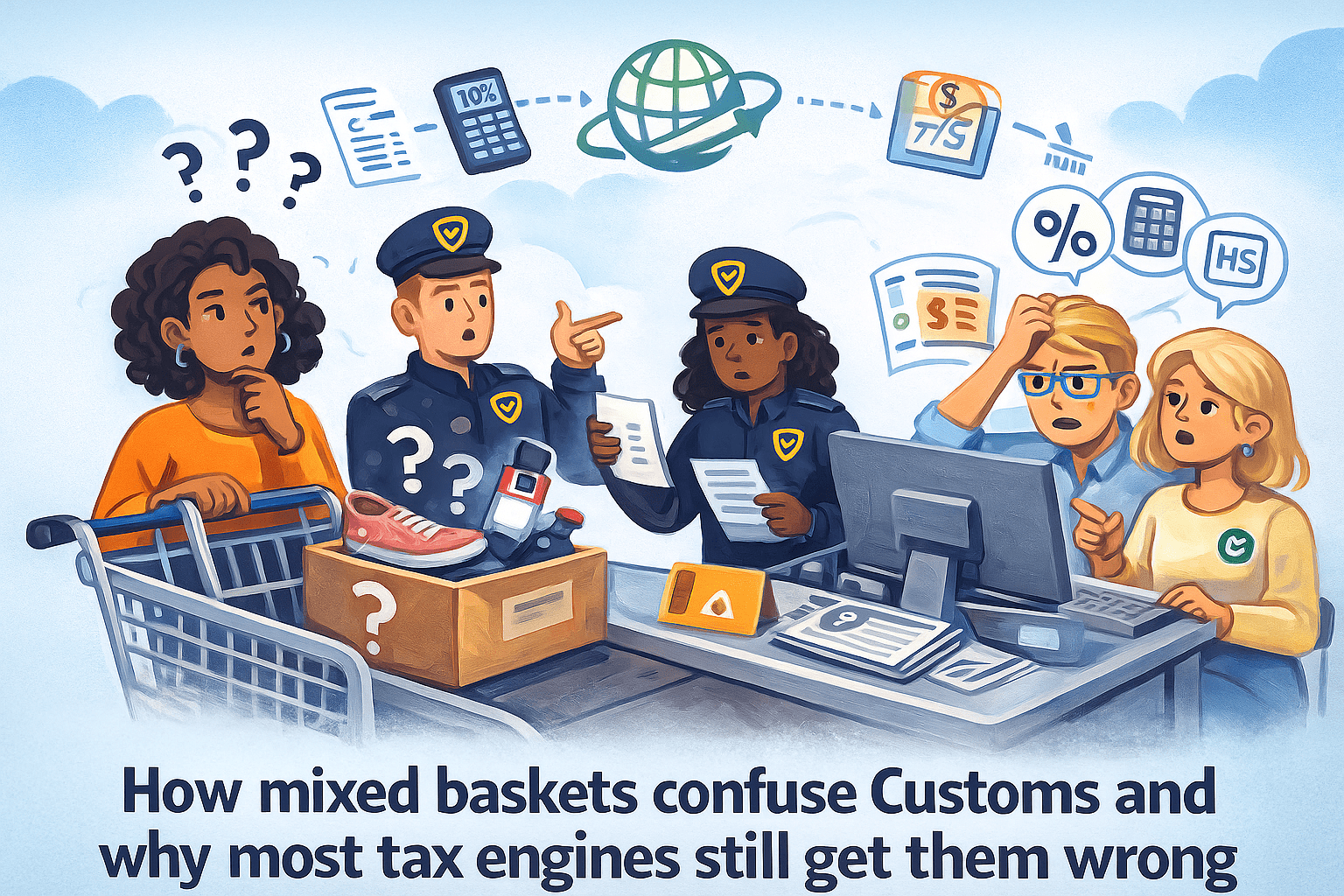
How mixed baskets confuse Customs and why most tax engines still get them wrong

How mixed baskets confuse Customs and why most tax engines still get them wrong

There is something charmingly simple about a single product checkout. One SKU, one VAT rate, one duty rate, one HS code, one shipping rule. It is the regulatory equivalent of a calm Sunday morning. Everything is where it should be and nothing surprises anyone.

Unfortunately most customers do not shop that way. They buy a pair of shoes, a notebook, a skincare product and a bottle of vitamins in one go. They mix standard rate with reduced rate. They blend products that are zero rated with products that trigger excise. They add an item that is IOSS eligible next to an item that pushes the order across the €150 threshold. They create a basket that makes perfect sense to them and absolutely no sense to the tax engine behind the scenes.

It is exactly here, in the cheerful chaos of mixed baskets, that cross border eCommerce usually breaks. Quietly.

Why mixed baskets are where compliance goes to die

Most legacy tax engines and plugin calculators were built for a simpler world. They take a shortcut. They work out a single VAT rate, apply it to the whole basket, guess at a duty rate if needed, apply a shipping tax rule (usually the wrong one) and then call it a day. It is clean, simple and almost always wrong when the basket is ‘complex’.

Mixed baskets demand a different mindset. Customs does not care about convenience. Customs cares about what each item is made of, what rate applies to it specifically and how the shipping cost must be allocated on a per line basis. A leather shoe is not a notebook. A notebook is not a vitamin supplement. A supplement is not a face cream. And Customs is not amused when systems pretend otherwise.

This is not an edge case. This is the real world. And it is where most deployments of IOSS, DDP and any kind of fully landed cost calculation begin to wobble.

The five silent failure points inside every mixed basket

There are five places where mixed baskets go wrong long before a parcel reaches a border.

1. VAT rates that refuse to cooperate

One product is standard rate. One is reduced rate. One is zero rated. The customer sees a simple basket. The tax authorities expect to see three separate tax regimes. eCommerce checkouts are supposed to know this. Most don’t. They choose a single VAT rate. It is the wrong choice and it affects shipping VAT, refunds and IOSS eligibility. And it almost always makes the basket price higher than it should be – never lower.

2. Shipping tax apportionment rules that vary by country and product mix

In Germany shipping tax must be allocated proportionally across each line in the basket. In France shipping often defaults to the highest VAT rate in the basket. In other jurisdictions shipping might attract no tax at all. In jurisdictions that don’t specify exact rules, they often state shippers must use a “reasonable” method of apportionment (whatever ‘reasonable’ might mean). Mixed baskets can create a variety of apportionment patterns in a single checkout. Most tax engines simply ignore this and charge VAT at the standard rate. This almost always results in more VAT than required being charged to the consumer – never less.

3. IOSS eligibility that changes product by product

IOSS is a scheme for consignments below €150 excluding shipping and tax / VAT (meaning, any tax that’s in the product before it sails across a border). One item might be eligible. Another might push the basket over the threshold. The difference at borderline basket values can depend on the destination VAT rate and official EU FX. A mixed basket can qualify for IOSS at checkout and fail the moment Customs recalculates the value using FX rates from 3 weeks earlier. Many tax engines do not test basket eligibility using the rules Customs actually use.

4. Duty calculation that needs HS10 or HS11, not HS6

HS6 is not enough for accurate duty. Many products diverge at the tenth or eleventh digit. Mixed baskets often contain items that look similar but fall into different classifications. If a system applies a generic HS6 rate to everything it introduces errors that compound when shipping VAT and IOSS validation are layered on top. Even if the 10th or 11th digit don’t affect the Duty rate, some countries insist on them being included in the data and declarations because they use them for statistical analysis of imported goods. If not present, the consignment can trigger an inspection. Many systems only allow for a single HS code to be used and that’s usually the (common) HS6 code instead of the country-specific HS10 or HS11.

5. Refund logic that falls apart when shipping VAT was wrong in the first place

When customers return part of a mixed basket the merchant must refund tax on the returned item and sometimes tax on shipping associated with that item. If the original shipping VAT was miscalculated or misallocated the refund becomes unsynchronised with the declarations submitted to Customs. This creates audit risk and mismatched financial records.

None of these issues surface when a buyer purchases a single product. They only appear when baskets behave like baskets. Which is to say: they appear most of the time.

Why most tax engines struggle with this

Mixed baskets require line-level (i.e. product-level) precision, country specific rules and a detailed understanding of how taxes, duties and shipping costs interact. They also require a valuation engine that understands the strange but very real world of tax on duties and tax on shipping with product-level apportionment rules and the official threshold logic that Customs applies, whether merchants like it or not.

Legacy engines and plugin calculators usually operate at basket level, not line level. They rely on static mappings, simplified assumptions, incomplete classification, generic VAT rules and shipping logic that does not reflect what happens at the border. They cannot apply ten different rules to five different line items in real time because they were never built to.

Merchants rarely see the error. They only see the outcome: delayed consignments, rejected packages, customers who refuse to pay extra charges and carriers who send back invoices with the phrase “incorrect declaration” printed politely but firmly at the top.

This is exactly the problem ePAL was created to solve

Mixed baskets are not unusual. They are the norm. They are also the reason ePAL treats every basket as a set of independent line items with their own rules, their own classifications and their own tax logic. And then treats the collection of items (i.e. the basket) as another item with it’s own set of rules.

Here is what ePAL does that most others do not.

1. Each product is classified separately using HS10 or HS11.

No approximations. No “close enough matches”. No relying on HS6 when Customs requires HS10. Each product receives a precise classification before any tax or duty logic is applied.

2. VAT is calculated per line at the correct product rate

If a basket contains four VAT rates, ePAL applies four VAT rates. It does not flatten them into one. It does not guess. It does not round. It calculates accurately.

3. Shipping VAT apportionment follows the rules of the destination country

If the country uses proportional allocation, ePAL applies it. If the country uses “highest rate in the basket”, ePAL applies that. If the country does not have any specified rules, ePAL does what is “reasonable” (and the Merchant is therefore protected by ePAL’s reasonableness test). If the country has exceptions for certain product categories, those exceptions are applied too. Line by line. And then at the basket level.

4. IOSS eligibility is tested using the official EU customs FX rate

This prevents the classic “looks like €149.99 at checkout but is €150.07 at the official EU rate” error that breaks shipments. ePAL runs the test correctly and silently and identifies the basket as IOSS or DDP as required so the Merchant can easily see which shipping flow to use. And then ePAL facilitates creation of the correct documentation (because, of course, they’re different!).

5. Duties are calculated per line using the correct base value

Some items attract duty only above thresholds. Others attract excise. Others trigger flat fees. Some require tax on duty. Some items oddly have more than one Customs Duty (Crispbread and Watch Casings are our favourite test products). ePAL handles all of it, per line item, in milliseconds.

6. Refund logic remains consistent because the original calculations were correct

When a customer returns item two from a six item basket, both the tax on the item and any associated shipping VAT can be refunded correctly. This keeps the merchant’s financial and Customs records in sync.

Mixed baskets are cross border eCommerce in its natural state

Customers mix products. Regulations mix rules. Customs mixes tax, duty and shipping logic. The only party that should not be mixing anything is the merchant. Mixed baskets defeat most systems because they were designed for simplicity, not reality. ePAL was designed for reality.

The world now expects clarity at checkout. It expects “no surprise costs at delivery”. It expects taxes and duties to be correct and complete. That level of confidence is not built on guesswork. It is built on understanding that every item in a basket carries its own regulatory truth.

Mixed baskets are complex but they do not have to be confusing. That is what ePAL fixes, quietly, line by line, long before a parcel ever leaves the warehouse.

Visit www.ePALGlobal.com for more info

Posted on Leave a comment

Why IOSS vs DDP Is Still Breaking Cross-Border Commerce and How ePAL Fixes It

ioss-v-ddp-with-epal.png

Why IOSS vs DDP Is Still Breaking Cross-Border Commerce and How ePAL Fixes It

Cross-border eCommerce has a reputation problem. Not because the products are bad or the merchants are untrustworthy, but because the systems behind the purchase are still stuck in a world where borders are physical, data travels slowly and tax authorities assume merchants have the free time and emotional resilience of a Vulcan tax accountant with an obsessive love of rules, regulations and reporting.

The infographic here – IOSS vs DDP – looks charming. Two tidy columns, friendly characters, neat speech bubbles. But beneath that cheerful exterior is the uncomfortable truth: today’s cross-border tax frameworks leave merchants navigating two entirely different worlds, and neither of them was designed with modern eCommerce in mind.

Let’s break it down.

Column 1: IOSS – Lovely in Theory, Limited in Reality

The IOSS (Import One-Stop Shop) scheme was introduced by the EU to simplify life for merchants selling low-value goods (€150 or below). On paper, it’s elegant:

  • Merchant calculates VAT at checkout.
  • Merchant reports & pays that VAT monthly via a single IOSS return.
  • No customs duties apply, because IOSS is strictly for low-value goods.

Simple. Predictable. Clean.

The result? A friction-free customer experience if and only if the order:

  1. Is €150 or below (excluding shipping)
  2. Ships from outside the EU to a consumer in the EU
  3. Contains products that don’t attract duties
  4. Follows the IOSS rules perfectly at every step – including the carrier’s side

That’s a very tight circle. And it can often exclude a significant portion of the Merchant’s baskets – everything with a basket total above €150.

The moment the basket creeps over €150, or one product triggers a duty (e.g. Excise), or a country requires additional classification digits (hello Germany), the IOSS flow collapses. The merchant has to switch to DDP or DAP, the carrier applies different rules (and probably higher rates) and the buyer gets an invoice they weren’t expecting.

Cue frustration, confusion, and the now-familiar “I ordered a €20 item and they tried to charge me €32 at the door” review.

IOSS is not the villain — it’s simply not capable of handling the rich, messy diversity of real-world cross-border commerce.

Column 2: DDP – The Grown Up Flow With Its Own Set of Nightmares

Delivered Duty Paid (DDP) is the serious sibling. The “we’ll take care of everything” option. Here, the merchant:

  • Calculates taxes and duties at checkout.
  • Ensures those amounts are actually sent to customs via the carrier, broker, or importer.
  • Handles every compliance, declaration, and classification step required for import.

In DDP, the customer is protected from nasty surprises. The price they saw online really is the price they pay. But DDP has one giant problem: you must get every detail right.

To calculate the correct fully landed cost, a merchant (or their platform) needs to know:

  • Country-specific VAT rates (at both ‘ship from’ and ‘ship to’ countries)
  • Country-specific ‘tax on shipping’ rules
  • Product-specific HS10 or HS11 classification
  • Country-specific duty rates for every HS10 or HS11 code
  • Duty thresholds
  • Excise rules
  • Flat fees, tariff quotas, special charges
  • Whether taxes compound on duties (yes, in many countries they do)

And just to spice things up, the rules change if:

  • The item is leather instead of synthetic,
  • The basket contains multiple items with mixed VAT rates,
  • One product is low-value and another isn’t,
  • The product is considered a “sports article” in one country and “fashion” in another,
  • A country requires classification digits beyond HS10,
  • Or the carrier applies its own interpretation of the regulations.

In other words: DDP requires perfect data, different players have different rules on what ‘perfect’ means and most merchants absolutely do not have perfect data.

That’s how even the most well-intentioned DDP flows end up producing packages stopped at customs, mis-declared duties, delays, surcharges, return-to-sender events, and the most miserable of Merchant-Customer outcomes: a Courier arriving with a bill instead of a delivery.

The Real Problem: Merchants Shouldn’t Have to Live in This Complexity

Merchants want to sell products, delight customers, and grow their business.

They didn’t sign up to become:

  • amateur customs experts,
  • part-time tariff researchers,
  • HS code detectives, or
  • tax reconciliation specialists.

Yet today, cross-border eCommerce forces merchants into this role.
Not because they want it — because without doing it, they risk:

  • Abandoned carts
  • Refused deliveries
  • Unexpected charges
  • Returned parcels
  • Support tickets
  • Margin erosion
  • Negative reviews
  • Financial penalties

And worst of all: customers losing trust in the brand.

Back to the picture

The two columns demonstrate a harsh truth: IOSS is too limited; DDP is too complicated. Most merchants sell baskets for both and many fall through the cracks between the two systems.

This Is Exactly the Gap ePAL Fills

ePAL was created for the world that exists now – not the regulatory frameworks of 2015 or the carrier workflows of 2008.

Where IOSS is limited and DDP is overwhelming, ePAL makes the entire journey simple, accurate, and compliant.

Here’s how ePAL fixes the mess:

1. Product classification becomes automatic

No more guessing HS codes.
No more spreadsheets.
No more “HS6 looks close enough.”

ePAL identifies the correct classification per product, per country.

2. Tax & duty calculation becomes instant and precise

Every VAT rate.
Every duty threshold.
Every shipping-tax rule.
Every country-specific nuance.
Every detail handled in milliseconds.

Whether it’s IOSS-eligible or DDP-required, the system automatically applies the correct logic.

3. The customer sees the real price at checkout

No estimates.
No small print.
No surprises later.

Just honest, compliant, fully landed pricing.

4. Declarations, data, and handovers are correct by default

The carrier gets the right data.
Customs gets the right declarations.
Shipments clear faster.
Successful deliveries increase.
Returns or rejections fall.
Support tickets evaporate.

5. Everyone in the chain benefits

  • Merchants increase conversions and reduce returns.
  • Buyers regain trust in cross-border shopping.
  • Carriers eliminate failed deliveries and awkward doorstep tax disputes.
  • Platforms gain cross-border capability without building tax engines.

The Big Picture: Trust Is the Real Currency of Cross-Border Commerce

Whether you use IOSS or DDP, the underlying truth is the same:

What customers want is certainty.

They want to know:

  • what they’re paying,
  • why they’re paying it,
  • and that the parcel will arrive without drama.

That’s not a tax problem. It’s a trust problem.
And trust is exactly what ePAL restores.

IOSS alone can’t do it.
DDP alone can’t do it.
Merchants alone definitely can’t do it.

But a unified, intelligent, behind-the-scenes engine built for today’s cross-border reality (aka ePAL)..? That can.

For more, see www.ePALGlobal.com

Posted on Leave a comment

When the Cost of Cross-Border Compliance in eCommerce Is Your Competitive Advantage

If you’re selling from outside the EU or expanding your reach within it, you’ve probably already discovered that “going cross-border” means more than just adding a few shipping zones to your checkout. It means mastering a patchwork of tax regimes, customs codes, trade thresholds, product classifications, safety standards, and the invisible monster: compliance.

The EU is one of the most lucrative online markets in the world but it’s also one of the most heavily regulated. For many merchants, that combination feels like standing at the gates of opportunity holding a suitcase full of paperwork and facing off against a battalion of bureaucrats.

The invisible barrier to growth

Here’s the irony: the same rules designed to make European trade fair and predictable can make it feel unpredictable to the merchants trying to comply. A single SKU can trigger five different tax and duty outcomes depending on its composition, packaging, and declared purpose. A €149 basket might pass smoothly through IOSS, while a €151 basket of the same goods triggers full customs duties, additional VAT and handling charges that turn profit margins into rounding errors.

Behind each transaction lies a maze of logic:

  • HS codes that decide what a product is for regulatory purposes. And you might be amazed by the result.
  • Tariff & Duty schedules that decide how much duty to charge and whether it’s based on weight, value, or category.
  • Country-specific tax rules that might apply standard, reduced, or zero rates (sometimes all three within the same basket).
  • Shipping tax apportionment that requires tax on delivery to be recalculated line-by-line depending on product type.
  • Customs thresholds that change at €150, or sometimes don’t, depending on how “intrinsic value” is defined.

Multiply this across 27 EU member states and thousands of products and it’s easy to see why merchants hesitate. The complexity isn’t theoretical – it directly affects pricing, profit and customer experience.

The false economy of “just get it through”

Most small and mid-sized sellers take a pragmatic shortcut: estimate, approximate, and hope for the best. Maybe the plugin you use adds VAT automatically and maybe it’s at the “Standard Rate” (which means you’ll never undercharge VAT… but also means you might often overcharge and that makes your prices uncompetitive).

It works… until it doesn’t. Your “close enough” becomes expensive the moment a package hits customs with missing data or incorrect tax, duty or classification. Then comes the chain reaction:

  • Parcels delayed (even if they’re eventually release with no additional costs)
  • Or maybe simply refused by your Customer if there are additional charges.
  • Angry customers who thought they’d already paid in full.
  • Unexpected invoices for duties or taxes you didn’t collect from your Customer.
  • Refunds that no longer match your original tax declarations.
  • Support tickets and return costs that quietly eat your margin.

Compliance mistakes don’t scale: they compound.
And the more successful you become, the more they cost.

The paradox of compliance

The smartest merchants already know that compliance isn’t a checkbox; it’s a commercial function. Done properly, it builds trust, protects margins, and turns cross-border operations from guesswork into growth.

Because when you understand the real landed cost of your goods, you can do more than just stay legal. You can price confidently, advertise truthfully, and deliver predictably. And you can often find that your goods are cheaper than your competitors’ simply because they’re complaint.

That clarity isn’t just good governance. It’s good marketing. Think of it like this:

  • Transparency is the new loyalty program.
    Shoppers who know exactly what they’ll pay are far more likely to complete checkout and to come back. Conversely, if your Customer gets a shock at delivery, you may never even hear about it – or from them – again.
  • Speed is the new discount.
    Consignments with correct data clear customs faster. That means earlier deliveries, fewer exceptions and lower carrier penalties.
  • Predictability is the new growth lever.
    When your costs are stable, your pricing and promotions can be too. You’re no longer buffering your margins to cover uncertainty.

In short: what looks like a regulatory burden is, in fact, a strategic advantage if you can make it predictable.

Predictability: the currency of trust

To achieve that predictability, you need precision. And precision in the EU means understanding how taxes and duties interact in ways that aren’t obvious to the naked spreadsheet.

For instance:

  • In Germany, VAT on shipping must be proportionally distributed across each product in a basket, based on its tax rate.
  • In France, shipping might default to the highest VAT rate in the basket.
  • In Ireland, a book shipped with a toy can shift the whole consignment’s tax treatment.

Those differences sound small until you scale up — then they’re the difference between a 22% margin and a 9% one.

Most systems don’t catch this level of nuance. They aren’t built to. They handle single products, not mixed consignments; simple duties, not layered taxes-on-taxes. But regulators are looking. Customs data checks are increasingly automated. A missing 11th digit in a product’s classification code can stop a shipment cold at the German border, even though it doesn’t affect the Tax or Duties.

Merchants don’t want to be customs experts. Shoppers don’t want to read footnotes. Yet somewhere in between, someone has to get the calculations right.

The moment compliance becomes competitive

Here’s where the opportunity flips. Imagine being the seller who can say (with confidence) “No surprise costs at delivery.” Imagine showing the full, accurate, compliant price before checkout, broken out item-by-item, tax-by-duty. Imagine your customer never having to wonder whether “import fees may apply.” That’s not just compliance. That’s customer experience.

And it’s exactly where ePAL Global gives merchants their edge.

From compliance cost to commercial clarity

ePAL was built for the mess behind the maths – for multi-product consignments, tax-on-duty calculations, tariff rules and Shipping VAT apportionment that most systems skip. It maps product classifications, identifies the right HS10 or HS11 codes for each destination, retrieves the correct duty, tax, and excise rates, and then calculates the true fully landed cost… all in real time during Checkout.

It’s not about estimates; it’s about precision. So instead of guessing how customs will treat your products, you know. Instead of buffering your prices “just in case,” you can price with confidence. Instead of losing orders to cart abandonment, you can convert with transparency.

The result: the price your customer sees is the price they pay.
No extra invoices. No stranded parcels. No fine print.

What that means for your business

For merchants expanding into the EU, predictability changes everything:

  • Pricing accuracy means fewer margin surprises.
  • Declared compliance means faster customs clearance.
  • Transparent checkout means higher trust and conversion.
  • Reduced support overhead means more bandwidth for growth.

And for established exporters, it means being able to operate cross-border without building a compliance department or hiring a customs broker for every product category.

It’s compliance-as-a-service, in the truest sense, delivered through a single API or plugin that slots directly into your existing checkout.

The numbers that matter

With ePAL Global, compliance isn’t a cost sink – it’s a fixed, predictable value:

  • 1.5% of cross-border baskets for eCommerce merchants.
  • €999 per year for importers and exporters.

That’s it. No hidden duties, no sliding-scale brokerage, no post-delivery surprises.

When you can quantify your compliance cost, you can treat it like any other line of business: predictable, measurable, and optimisable.

The bigger picture

The future of cross-border eCommerce belongs to the merchants who treat compliance not as a defensive shield, but as an offensive strategy – a differentiator based on transparency and trust.

In an era where customers expect clarity, regulators demand accuracy and competitors are just one click away, the ability to promise “no surprises” isn’t just good ethics, it’s good business.

That’s the world ePAL Global was built for: a world where merchants can expand confidently, sell compliantly, and deliver seamlessly across every border, every basket, every time.

ePAL Global: turning the cost of compliance into your competitive advantage for eCommerce merchants, importers and exporters. No surprises. No uncertainty. Just clarity… delivered.

For more, see www.ePALGlobal.com

Posted on Leave a comment

When “Delivery” is just the beginning of the Merchant’s problems

Cartoon-when-delivery-is-only-the-start-of-the-problem


Cross-border eCommerce has a trust problem.

Every day, somewhere in the world, a shopper clicks “Buy Now” convinced that the price on the screen is the price they’ll pay. A few days later, a courier appears at the door with a parcel in one hand and a surprise invoice in the other. That’s if the package even shows up. Maybe the only thing the buyer receives is an expected ransom demand: pay us more money or the parcel gets it

The buyer feels tricked- the seller feels blamed- and the carrier gets caught in the middle. It’s an awkward triangle built out of good intentions and bad visibility.

The hidden costs of “almost right”
Most checkouts for cross-border transactions are technically correct. They add VAT where needed, estimate shipping, maybe even flag import duties in small print. But “technically correct” is the kind of terminology Legal departments use… Marketing departments don’t want to tell their customer to ‘read the small print’. At least, not if they want the customer to return. 

Buyers remember the ‘surprise’ additional fees, charges and delays, not the footnote in the terms & conditions.

Sellers remember the headache and hassle of returns and refunds, not the regulations.

And the logistics provider remembers another failed delivery that wasn’t its fault.

The result?

  • Cart abandonment rates soar when duties aren’t clear & present until payment tim[Dd1] e.
  • Deliveries are delayed at import time because of missing Tax & Customs duty data.
  • Deliveries are rejected by the customer because they arrive with additional charges.
  • Consignments are returned at the Seller’s cost or destroyed by Customs if not returned.
  • Support teams drown in “Why was I charged extra?” messages.
  • Repeat sales drop, even when the product  and site were otherwise great.

In short: cross-border commerce works but it just doesn’t feel “trustworthy” to the buyer. And that feeling matters more than the Maths (or the small print).

The cross-border complexity that no-one signed up for
Behind every international order lives a web of hidden detail. There are product classification codes, tariff rates, duty thresholds, de-minimis limits, country-specific Tax rates, product-specific Duty rates, country-specific rules for calculating Tax on the Shipping costs, restricted goods & restricted buyer lists, rules for reclaiming Tax on refunded consignments… and more.

  • A pair of shoes might attract no duty in one country but 8% in another, depending on whether it’s leather, synthetic or a “sports article.” The Duty might only apply if they cost €150.01 or more or they’re shipped in a consignment with other products that together total €150.01 or more, regardless of what they originally cost.
  • Tax on goods in some countries is zero. For example, printed matter.  But unless the systems know what kind of printed matter the goods are (books, leaflets, maps, diaries & desk planners) the standard rate will be applied. This matters because it makes the product up to 27% more expensive. And then adds another unnecessary 27% to the tax on shipping.
  • A platinum wristwatch might attract standard Customs Duty, the same as any other product, but if the watch case is shipped alone (e.g. as a replacement part), it might attract Duty using a complicated calculation (sort of, but not quite correctly, summarised as “50c but only if 50c is between 2.7% and 4.6% of the price charged”). This changes the price the Customer has to pay.
  • Tax on shipping might be routinely charged at high ‘standard’ rates of tax (therefore pushing prices up) when, in fact, the Country-specific regulations might allow Shipping Tax to be reduced or even zero for many consignments and may even allow different rates of ‘tax on shipping’ for each item in the basket. This matters when tax refunds are made for returned goods.
  • A luxury item might sail through customs in Singapore yet get stopped in Spain because of packaging labelling rules. This matters because it delays the delivery and may incur handling charges for delays caused.
  • Products sent to any Country in the EU might sail through automated data checking but the same product might be stopped at the border in Germany because the advanced data shared by the Merchant via their Carrier is missing an 11th classification digit for each Product. This matters when the consignment arrives at the German border and is stopped for incomplete data.

And if you sell through your own website and via a marketplace, you may have two conflicting sets of tax obligations without realising it.

Merchants shouldn’t have to care about any of this. Customers certainly shouldn’t – and often don’t… they just buy elsewhere.

This is not territory most merchants want to navigate – but ignoring it isn’t an option. Compliance is no longer an afterthought – it’s the cost of doing business. Yet most sellers, even large ones, rely on incomplete plugin services, manual spreadsheets or carrier calculators that show only part of the picture.

Ask anyone who’s spent time in last-mile logistics and they’ll tell you: the delivery driver becomes the unwilling ambassador of every unclear transaction. They’re the ones who face the shopper’s frustration at the door, even though the surprise charge came from upstream systems they’ve never seen.

Each failed delivery costs time, money, and goodwill – not just for the seller, but for the entire ecosystem that touched that parcel. Multiply that by millions of cross-border orders a day, and you have a global leak of trust and efficiency.

 Enter ePAL: clarity at checkout
That’s the gap ePAL was built to close.

ePAL gives sellers, platforms, and logistics providers a shared, accurate view of the fully landed cost: the true end-to-end cost of getting a product from one country to another, including duties, taxes, and fees.

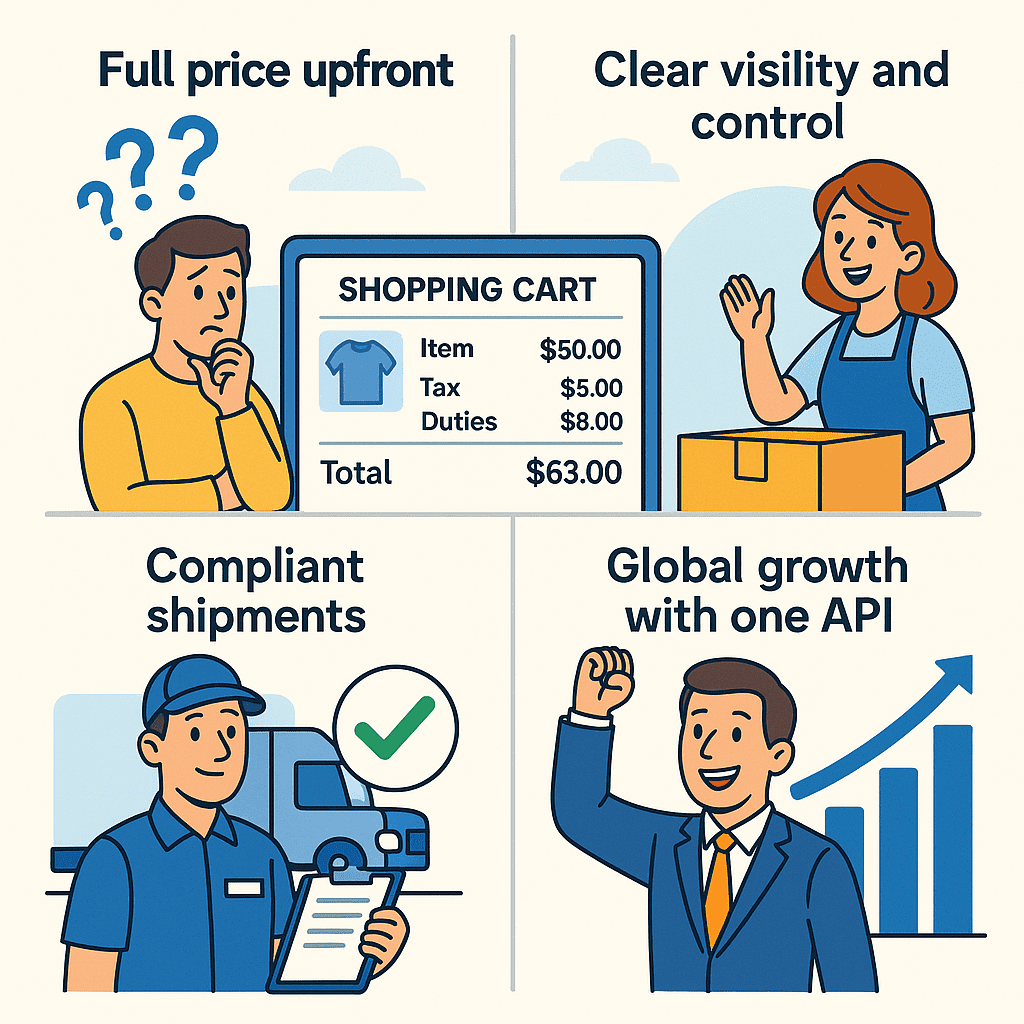
In simple terms: ePAL allows the buyer to see the total, compliant price before clicking ‘Buy’ and allows the Merchant to be sure neither they nor their customer will have any nasty surprises.

ePAL Global is a behind-the-checkout API or plugin that that identifies product classifications, tax & customs data, tariff schedules, and carrier networks. It calculates fully landed costs (aka Duty Delivery Paid or DDP) in real time in the checkout flow, based on product type, origin, destination and shipping method – all within milliseconds.

No more “estimated import fees.” No more awkward door-step negotiations or abandoned shipments. Just honest pricing, delivered instantly.

Transparency that pays for itself
When buyers see the total cost upfront, conversion rates improve.
When shipments are correctly declared, customs clearance accelerates.
When deliveries arrive without surprises, returned packages drop.

The economics are simple:
– Fewer failed deliveries → lower logistics costs & lower returns penalties.
– Fewer support tickets → happier operations teams.
– More repeat purchases → sustainable growth.

Trust becomes a measurable business outcome.

Built for everyone in the chain
For online sellers, integrate ePAL directly into your existing eCommerce platform or checkout. You don’t need to become a customs expert – the API does the heavy lifting.

For SaaS eCommerce platforms (e.g. WooCommerce), ePAL plugins allow Merchants to simply plug-and-play, integrating Tax & Duty calculations into existing stores in minutes.

For marketplaces, ePAL offers the invisible API orchestration layer to provide Duty Delivery Paid / Fully Landed Cost cross-border eCommerce capability to all your sellers..

For carriers and logistics providers, it reduces the failure points that damage reputation and margins. When every parcel leaves with the right declarations and fees already handled, the journey becomes predictable – and profitable.

From compliance burden to competitive edge
For years, “compliance” has been a word that caused eyes to glaze over but in cross-border eCommerce, compliance done well isn’t bureaucracy – it’s brand equity.

A merchant who can confidently say “No surprise costs at delivery” is instantly more trustworthy than one who can’t. The checkout becomes a promise, not a risk. And that confidence compounds across borders, currencies, and partnerships.

Clarity, confidence, compliance – in that order

ePAL isn’t just a calculator- it’s a communication tool. It translates regulatory complexity into consumer clarity. It helps sellers explain confidently what a parcel really costs, and it helps shoppers feel sure that what they see is what they’ll pay. That shift – from opaque to transparent – changes behaviour.

  • Buyers choose certainty.
  • Sellers gain loyalty.
  • Carriers gain reliability.
  • Everyone wins because everyone sees the same truth.

Why now?
The timing matters. Global eCommerce has outpaced the systems that govern it. Post-pandemic acceleration, tariff tantrums, regional tax reforms and the rise of micro-fulfilment networks have turned yesterday’s best practices into today’s liability.

Consumers now expect the same clarity buying from Seattle as they do from Sheffield, the same upfront certainty from long-distance sales as from local. The only way to deliver that consistency is to bring the invisible parts of cross border eCommerce – duties, taxes, compliance – into the equation, automatically.

That’s the future ePAL was built for: a world where cross-border eCommerce is as seamless, compliant, and transparent as domestic shopping.

Every great eCommerce innovation has simplified something people thought was inherently complex. Payment gateways demystified card processing. Digital wallets removed friction. Real-time tracking made shipping visible. Now it’s time to make fully landed cost quick, easy & transparent. This is why ePAL was created.

The bigger picture
What we’re really addressing isn’t just tax or shipping – it’s trust.

  • Trust that the price is honest.
  • Trust that the delivery will happen as promised.
  • Trust that global commerce can be simple, lawful, and fair for everyone involved.

In that sense, ePAL isn’t only a platform. It’s an enabler of better relationships across borders: between sellers and buyers, merchants and carriers, regulators and innovators. Because when clarity becomes normal, trust becomes easy and when trust is easy, global trade grows.

At ePAL, we believe global shopping shouldn’t require fine print or apologies. The total cost should be clear before the click – not after the knock on the door.

That’s what we’re here to deliver.

In one line: ePAL makes cross-border eCommerce simple, safe & transparent for everyone.

For more, see www.ePALGlobal.com