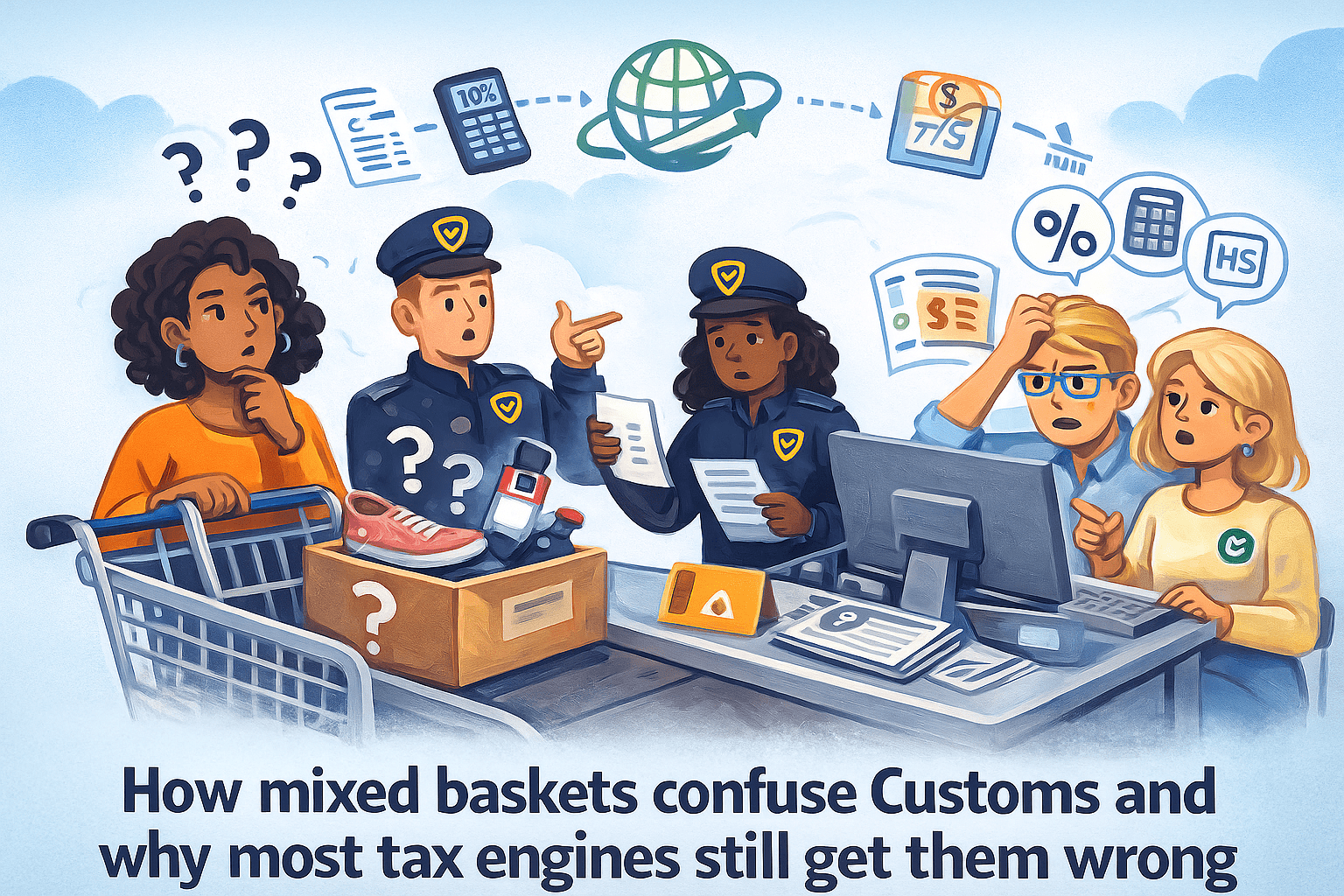
There is something charmingly simple about a single product checkout. One SKU, one VAT rate, one duty rate, one HS code, one shipping rule. It is the regulatory equivalent of a calm Sunday morning. Everything is where it should be and nothing surprises anyone.
Unfortunately most customers do not shop that way. They buy a pair of shoes, a notebook, a skincare product and a bottle of vitamins in one go. They mix standard rate with reduced rate. They blend products that are zero rated with products that trigger excise. They add an item that is IOSS eligible next to an item that pushes the order across the €150 threshold. They create a basket that makes perfect sense to them and absolutely no sense to the tax engine behind the scenes.
It is exactly here, in the cheerful chaos of mixed baskets, that cross border eCommerce usually breaks. Quietly.
Why mixed baskets are where compliance goes to die
Most legacy tax engines and plugin calculators were built for a simpler world. They take a shortcut. They work out a single VAT rate, apply it to the whole basket, guess at a duty rate if needed, apply a shipping tax rule (usually the wrong one) and then call it a day. It is clean, simple and almost always wrong when the basket is ‘complex’.
Mixed baskets demand a different mindset. Customs does not care about convenience. Customs cares about what each item is made of, what rate applies to it specifically and how the shipping cost must be allocated on a per line basis. A leather shoe is not a notebook. A notebook is not a vitamin supplement. A supplement is not a face cream. And Customs is not amused when systems pretend otherwise.
This is not an edge case. This is the real world. And it is where most deployments of IOSS, DDP and any kind of fully landed cost calculation begin to wobble.
The five silent failure points inside every mixed basket
There are five places where mixed baskets go wrong long before a parcel reaches a border.
1. VAT rates that refuse to cooperate
One product is standard rate. One is reduced rate. One is zero rated. The customer sees a simple basket. The tax authorities expect to see three separate tax regimes. eCommerce checkouts are supposed to know this. Most don’t. They choose a single VAT rate. It is the wrong choice and it affects shipping VAT, refunds and IOSS eligibility. And it almost always makes the basket price higher than it should be – never lower.
2. Shipping tax apportionment rules that vary by country and product mix
In Germany shipping tax must be allocated proportionally across each line in the basket. In France shipping often defaults to the highest VAT rate in the basket. In other jurisdictions shipping might attract no tax at all. In jurisdictions that don’t specify exact rules, they often state shippers must use a “reasonable” method of apportionment (whatever ‘reasonable’ might mean). Mixed baskets can create a variety of apportionment patterns in a single checkout. Most tax engines simply ignore this and charge VAT at the standard rate. This almost always results in more VAT than required being charged to the consumer – never less.
3. IOSS eligibility that changes product by product
IOSS is a scheme for consignments below €150 excluding shipping and tax / VAT (meaning, any tax that’s in the product before it sails across a border). One item might be eligible. Another might push the basket over the threshold. The difference at borderline basket values can depend on the destination VAT rate and official EU FX. A mixed basket can qualify for IOSS at checkout and fail the moment Customs recalculates the value using FX rates from 3 weeks earlier. Many tax engines do not test basket eligibility using the rules Customs actually use.
4. Duty calculation that needs HS10 or HS11, not HS6
HS6 is not enough for accurate duty. Many products diverge at the tenth or eleventh digit. Mixed baskets often contain items that look similar but fall into different classifications. If a system applies a generic HS6 rate to everything it introduces errors that compound when shipping VAT and IOSS validation are layered on top. Even if the 10th or 11th digit don’t affect the Duty rate, some countries insist on them being included in the data and declarations because they use them for statistical analysis of imported goods. If not present, the consignment can trigger an inspection. Many systems only allow for a single HS code to be used and that’s usually the (common) HS6 code instead of the country-specific HS10 or HS11.
5. Refund logic that falls apart when shipping VAT was wrong in the first place
When customers return part of a mixed basket the merchant must refund tax on the returned item and sometimes tax on shipping associated with that item. If the original shipping VAT was miscalculated or misallocated the refund becomes unsynchronised with the declarations submitted to Customs. This creates audit risk and mismatched financial records.
None of these issues surface when a buyer purchases a single product. They only appear when baskets behave like baskets. Which is to say: they appear most of the time.
Why most tax engines struggle with this
Mixed baskets require line-level (i.e. product-level) precision, country specific rules and a detailed understanding of how taxes, duties and shipping costs interact. They also require a valuation engine that understands the strange but very real world of tax on duties and tax on shipping with product-level apportionment rules and the official threshold logic that Customs applies, whether merchants like it or not.
Legacy engines and plugin calculators usually operate at basket level, not line level. They rely on static mappings, simplified assumptions, incomplete classification, generic VAT rules and shipping logic that does not reflect what happens at the border. They cannot apply ten different rules to five different line items in real time because they were never built to.
Merchants rarely see the error. They only see the outcome: delayed consignments, rejected packages, customers who refuse to pay extra charges and carriers who send back invoices with the phrase “incorrect declaration” printed politely but firmly at the top.
This is exactly the problem ePAL was created to solve
Mixed baskets are not unusual. They are the norm. They are also the reason ePAL treats every basket as a set of independent line items with their own rules, their own classifications and their own tax logic. And then treats the collection of items (i.e. the basket) as another item with it’s own set of rules.
Here is what ePAL does that most others do not.
1. Each product is classified separately using HS10 or HS11.
No approximations. No “close enough matches”. No relying on HS6 when Customs requires HS10. Each product receives a precise classification before any tax or duty logic is applied.
2. VAT is calculated per line at the correct product rate
If a basket contains four VAT rates, ePAL applies four VAT rates. It does not flatten them into one. It does not guess. It does not round. It calculates accurately.
3. Shipping VAT apportionment follows the rules of the destination country
If the country uses proportional allocation, ePAL applies it. If the country uses “highest rate in the basket”, ePAL applies that. If the country does not have any specified rules, ePAL does what is “reasonable” (and the Merchant is therefore protected by ePAL’s reasonableness test). If the country has exceptions for certain product categories, those exceptions are applied too. Line by line. And then at the basket level.
4. IOSS eligibility is tested using the official EU customs FX rate
This prevents the classic “looks like €149.99 at checkout but is €150.07 at the official EU rate” error that breaks shipments. ePAL runs the test correctly and silently and identifies the basket as IOSS or DDP as required so the Merchant can easily see which shipping flow to use. And then ePAL facilitates creation of the correct documentation (because, of course, they’re different!).
5. Duties are calculated per line using the correct base value
Some items attract duty only above thresholds. Others attract excise. Others trigger flat fees. Some require tax on duty. Some items oddly have more than one Customs Duty (Crispbread and Watch Casings are our favourite test products). ePAL handles all of it, per line item, in milliseconds.
6. Refund logic remains consistent because the original calculations were correct
When a customer returns item two from a six item basket, both the tax on the item and any associated shipping VAT can be refunded correctly. This keeps the merchant’s financial and Customs records in sync.
Mixed baskets are cross border eCommerce in its natural state
Customers mix products. Regulations mix rules. Customs mixes tax, duty and shipping logic. The only party that should not be mixing anything is the merchant. Mixed baskets defeat most systems because they were designed for simplicity, not reality. ePAL was designed for reality.
The world now expects clarity at checkout. It expects “no surprise costs at delivery”. It expects taxes and duties to be correct and complete. That level of confidence is not built on guesswork. It is built on understanding that every item in a basket carries its own regulatory truth.
Mixed baskets are complex but they do not have to be confusing. That is what ePAL fixes, quietly, line by line, long before a parcel ever leaves the warehouse.
Visit www.ePALGlobal.com for more info