Why IOSS vs DDP Is Still Breaking Cross-Border Commerce and How ePAL Fixes It
Cross-border eCommerce has a reputation problem. Not because the products are bad or the merchants are untrustworthy, but because the systems behind the purchase are still stuck in a world where borders are physical, data travels slowly and tax authorities assume merchants have the free time and emotional resilience of a Vulcan tax accountant with an obsessive love of rules, regulations and reporting.
The infographic here – IOSS vs DDP – looks charming. Two tidy columns, friendly characters, neat speech bubbles. But beneath that cheerful exterior is the uncomfortable truth: today’s cross-border tax frameworks leave merchants navigating two entirely different worlds, and neither of them was designed with modern eCommerce in mind.
Let’s break it down.
Column 1: IOSS – Lovely in Theory, Limited in Reality
The IOSS (Import One-Stop Shop) scheme was introduced by the EU to simplify life for merchants selling low-value goods (€150 or below). On paper, it’s elegant:
- Merchant calculates VAT at checkout.
- Merchant reports & pays that VAT monthly via a single IOSS return.
- No customs duties apply, because IOSS is strictly for low-value goods.
Simple. Predictable. Clean.
The result? A friction-free customer experience if and only if the order:
- Is €150 or below (excluding shipping)
- Ships from outside the EU to a consumer in the EU
- Contains products that don’t attract duties
- Follows the IOSS rules perfectly at every step – including the carrier’s side
That’s a very tight circle. And it can often exclude a significant portion of the Merchant’s baskets – everything with a basket total above €150.
The moment the basket creeps over €150, or one product triggers a duty (e.g. Excise), or a country requires additional classification digits (hello Germany), the IOSS flow collapses. The merchant has to switch to DDP or DAP, the carrier applies different rules (and probably higher rates) and the buyer gets an invoice they weren’t expecting.
Cue frustration, confusion, and the now-familiar “I ordered a €20 item and they tried to charge me €32 at the door” review.
IOSS is not the villain — it’s simply not capable of handling the rich, messy diversity of real-world cross-border commerce.
Column 2: DDP – The Grown Up Flow With Its Own Set of Nightmares
Delivered Duty Paid (DDP) is the serious sibling. The “we’ll take care of everything” option. Here, the merchant:
- Calculates taxes and duties at checkout.
- Ensures those amounts are actually sent to customs via the carrier, broker, or importer.
- Handles every compliance, declaration, and classification step required for import.
In DDP, the customer is protected from nasty surprises. The price they saw online really is the price they pay. But DDP has one giant problem: you must get every detail right.
To calculate the correct fully landed cost, a merchant (or their platform) needs to know:
- Country-specific VAT rates (at both ‘ship from’ and ‘ship to’ countries)
- Country-specific ‘tax on shipping’ rules
- Product-specific HS10 or HS11 classification
- Country-specific duty rates for every HS10 or HS11 code
- Duty thresholds
- Excise rules
- Flat fees, tariff quotas, special charges
- Whether taxes compound on duties (yes, in many countries they do)
And just to spice things up, the rules change if:
- The item is leather instead of synthetic,
- The basket contains multiple items with mixed VAT rates,
- One product is low-value and another isn’t,
- The product is considered a “sports article” in one country and “fashion” in another,
- A country requires classification digits beyond HS10,
- Or the carrier applies its own interpretation of the regulations.
In other words: DDP requires perfect data, different players have different rules on what ‘perfect’ means and most merchants absolutely do not have perfect data.
That’s how even the most well-intentioned DDP flows end up producing packages stopped at customs, mis-declared duties, delays, surcharges, return-to-sender events, and the most miserable of Merchant-Customer outcomes: a Courier arriving with a bill instead of a delivery.
The Real Problem: Merchants Shouldn’t Have to Live in This Complexity
Merchants want to sell products, delight customers, and grow their business.
They didn’t sign up to become:
- amateur customs experts,
- part-time tariff researchers,
- HS code detectives, or
- tax reconciliation specialists.
Yet today, cross-border eCommerce forces merchants into this role.
Not because they want it — because without doing it, they risk:
- Abandoned carts
- Refused deliveries
- Unexpected charges
- Returned parcels
- Support tickets
- Margin erosion
- Negative reviews
- Financial penalties
And worst of all: customers losing trust in the brand.
Back to the picture
The two columns demonstrate a harsh truth: IOSS is too limited; DDP is too complicated. Most merchants sell baskets for both and many fall through the cracks between the two systems.
This Is Exactly the Gap ePAL Fills
ePAL was created for the world that exists now – not the regulatory frameworks of 2015 or the carrier workflows of 2008.
Where IOSS is limited and DDP is overwhelming, ePAL makes the entire journey simple, accurate, and compliant.
Here’s how ePAL fixes the mess:
1. Product classification becomes automatic
No more guessing HS codes.
No more spreadsheets.
No more “HS6 looks close enough.”
ePAL identifies the correct classification per product, per country.
2. Tax & duty calculation becomes instant and precise
Every VAT rate.
Every duty threshold.
Every shipping-tax rule.
Every country-specific nuance.
Every detail handled in milliseconds.
Whether it’s IOSS-eligible or DDP-required, the system automatically applies the correct logic.
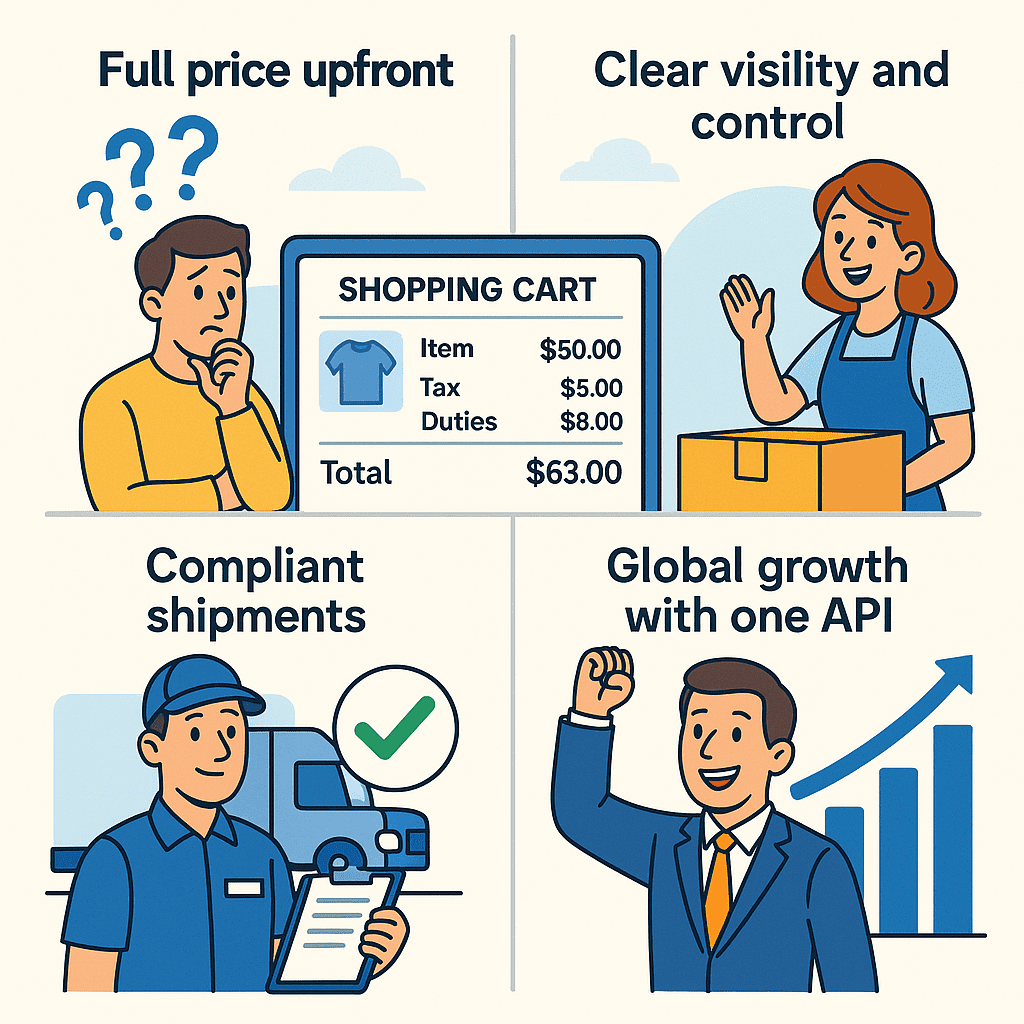
3. The customer sees the real price at checkout
No estimates.
No small print.
No surprises later.
Just honest, compliant, fully landed pricing.
4. Declarations, data, and handovers are correct by default
The carrier gets the right data.
Customs gets the right declarations.
Shipments clear faster.
Successful deliveries increase.
Returns or rejections fall.
Support tickets evaporate.
5. Everyone in the chain benefits
- Merchants increase conversions and reduce returns.
- Buyers regain trust in cross-border shopping.
- Carriers eliminate failed deliveries and awkward doorstep tax disputes.
- Platforms gain cross-border capability without building tax engines.
The Big Picture: Trust Is the Real Currency of Cross-Border Commerce
Whether you use IOSS or DDP, the underlying truth is the same:
What customers want is certainty.
They want to know:
- what they’re paying,
- why they’re paying it,
- and that the parcel will arrive without drama.
That’s not a tax problem. It’s a trust problem.
And trust is exactly what ePAL restores.
IOSS alone can’t do it.
DDP alone can’t do it.
Merchants alone definitely can’t do it.
But a unified, intelligent, behind-the-scenes engine built for today’s cross-border reality (aka ePAL)..? That can.
For more, see www.ePALGlobal.com