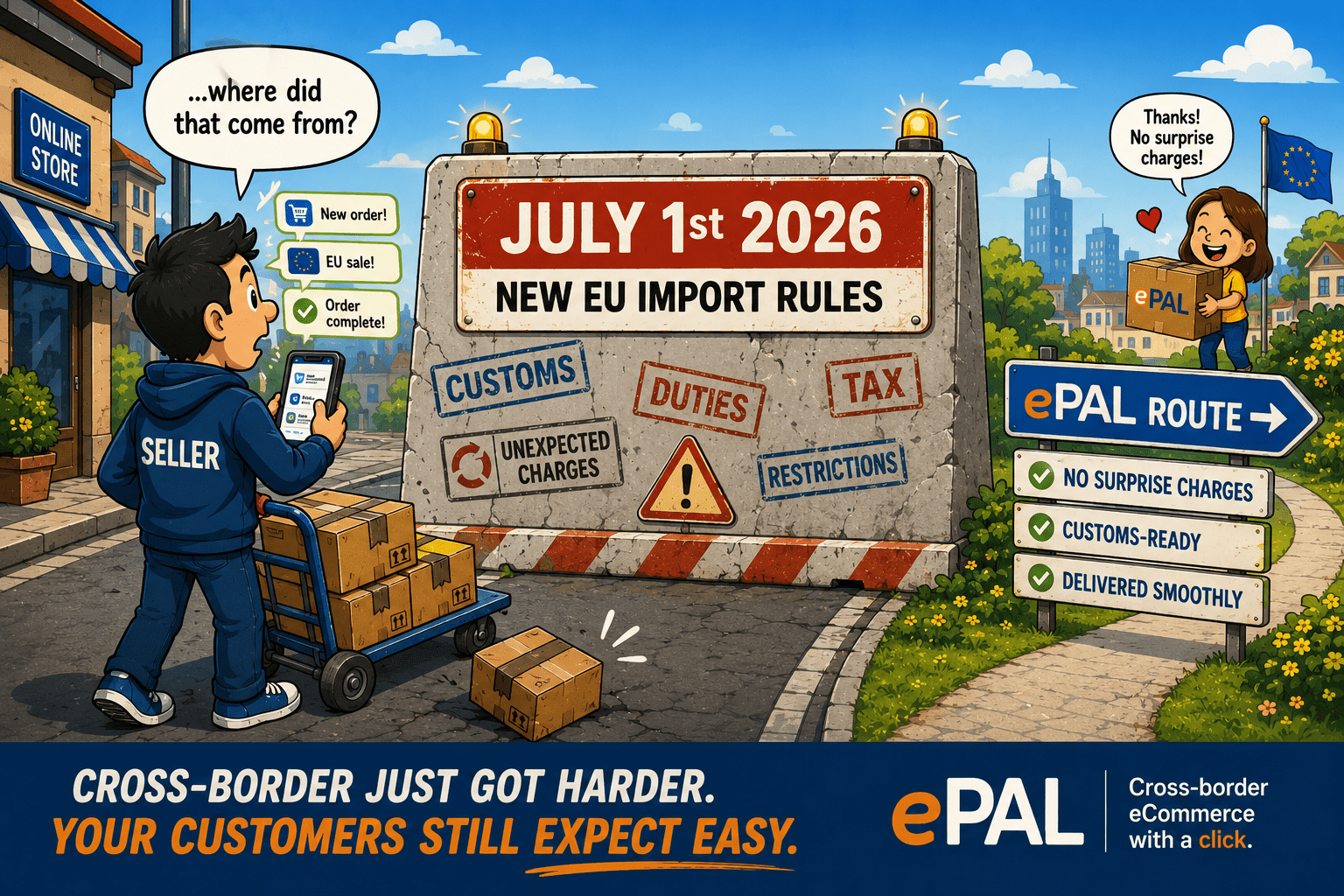
eCommerce merchants don’t wake up in the morning thinking about compliance. They think about sales, customers, growth, conversion rates, margins. Maybe even shipping costs (on a good day).
Compliance sits somewhere else entirely. In the background. In the “we’ll deal with that later… maybe” bucket. Somewhere between legal paperwork and going to the dentist. Important, obviously. But not urgent… until it is.
For eCommerce merchants selling into the EU, that time is now.
Read more: Nobody cares about compliance… until they have toThe invisible problem
The reality is simple. Most people do not care about compliance. They might just about care about the consequences of being non-compliant… if they’re caught.
Non-compliance is not front of mind for pretty much any eCommerce merchant because they do not experience it directly. Until they do.
Compliance is not a feature. It is not a benefit. It does not increase conversion rates. It does not make your product better – at least, not in any way that is visible.
So it gets ignored.
Part of the problem is that compliance is inherently complex. Not just complicated in the sense that there are many rules, but complex in the sense that those rules interact, overlap and sometimes contradict each other.
Tax authorities think one way. Customs authorities think another. Regulatory bodies think in their own domain entirely. Standardisation would help, in theory. In practice, administrators do not think alike. They never have. And they are not incentivised to.
So the burden falls on the merchant.

What compliance means in the real world
Strip away the jargon and compliance becomes surprisingly simple.
What must I do
What must I not do
What happens if I get it wrong
That’s it.
Ten years ago (almost exactly), I wrote about the concept that later became known as “Minimum Compliant Product”. The concept – one I have built a career on – is summarised as figuring out:
‘What is the minimum I must do to become, or remain, compliant with the regulations relevant to my business?’
In the world of eCommerce, some of the answers include:
- You must calculate & charge the correct tax. Then you must pay it to the correct tax authority. Not a similar amount of Tax to a similar Authority. The exact amount, calculated to the penny or cent, for every product in every basket, and paid to the correct Authority.
- You must identify the correct customs duty rate (not a random one or a ‘this will do’ rate) and calculate the correct customs duty amount. Then ensure it is declared and paid correctly.
- If you charge for Shipping, you must calculate the right Tax on Shipping, based on different rules for each Country you’re shipping to. And then you must apportion that total Tax across the all of the line items in the basket according to Country-specific rules.
- You must not sell goods into a country that does not permit them. Even if your website happily takes the order. Other goods have to be shipped with specific documents, specific warnings or specific packaging labels (such as ‘hazardous goods’).
But, even then, all of these have to be backed up with the “…and what happens if I don’t..?” question. Sure, you have to stay compliant with the Regulations… or else what? The rules themselves are almost irrelevant to most people. It is the consequences that matter.
And in cross border eCommerce, those consequences are very real, and they affect your bottom line. And they are about to become the norm.
For every single package.

July 1st, 2026: the moment it becomes real for every package
From July 1st this year, EU Customs authorities will implement a new set of cross border handling rules. It’s described in lots of pages of lots of regulatory-speak but the core message is this:
Y’know those packages containing goods worth less than €150 that are exempt from Customs Duties (aka Tariffs)…? Well, they won’t be any more.
So, what does that mean for you as an eCommerce merchant sending shiny new products to Customers in the EU? In other words, what’s the answer to ‘or else what..?’
- Or else all of your shipments will be stopped at customs.
- Or else all of your customers will be asked to pay unexpected charges at delivery.
- Or else all of your products will be returned to sender or destroyed by Customs.
- Or else multiple Tax authorities will be asking questions about imports that you can’t answer.
- Or else multiple Customs authorities will have all of your future shipments on a watch list.
- Or else your cross-border eCommerce trade will become an administrative nightmare.
- Or else you will just give up on half a billion EU Customers.
…not that we’re trying to be scaremongers…

We are all non compliant, all the time
Compliance only becomes visible when something goes wrong.
At that point, it stops being theoretical. It becomes operational, financial, reputational. And suddenly, everyone cares.
Outside of business, we live with non compliance every day.
Speed limits are a good example. Some people break them deliberately. Others break them because the limit is unclear, inconsistent or changes without warning. Others break them because, well… there are rarely any real consequences.
Either way, the behaviour is the same. Non compliance.
Parking rules. Tax returns. Terms and conditions that nobody reads. Import limits when travelling. Even something as simple as recycling rules that vary by location.
We are all, to some extent, selectively compliant.
Not because we want to break rules. Sometimes it is simply because it is easier to be non-compliant than compliant. Sometimes the effort required to understand and follow every rule is disproportionate to the perceived risk.
Until the risk becomes real.
The stick does not work on its own
Regulators traditionally rely on the stick: Fines. Penalties. Seizures. Audits.
This works, but only if people fear the stick. And in many cases, they do not. Or they underestimate the likelihood of being caught, so behaviour does not change.
The carrot is more interesting.
Make compliance easier. Make it predictable. Make it part of the normal flow of doing business rather than an additional burden.
If the compliant path is the easiest path, people will take it. If the non compliant path is easier, they will take that instead.
This is not a moral failing. It is human nature.
Cross border compliance as competitive advantage
Cross border eCommerce amplifies everything.
Different tax regimes. Different duty rules. Different product restrictions. Different interpretations. The distance between “works fine locally” and “fails internationally” is surprisingly small.
And the cost of getting it wrong increases with scale. More orders means more exposure. More jurisdictions means more complexity. More growth means more scrutiny.
Ignoring compliance does not make it go away. It just delays the moment when it becomes unavoidable. Sure, the merchant might not care about the right taxes or duties. But the customer does, especially when the inevitable “unexpected taxes, duties and handling charges” are added to the bill (and that’s every bill after July 1st). And then the customer refuses to pay it and demands a refund.
Until now, merchants could get away with just selling and forgetting about it… leave it as the customer’s problem.
Increasingly, Customs authorities in the EU and US (with other countries no doubt to follow) won’t even let the consignment enter the Country. They can be either returned to the merchant or – as is often the case – simply abandoned and eventually destroyed.
But, there is an opportunity hidden in all of this.

Customers lose trust in non-compliant Merchants & stop buying from them. Non-compliant Merchants stop selling to EU customers. Compliant Merchants pick up the slack. Everyone wins (except you).
Most merchants treat compliance as a cost. Something to ignore, minimise or defer. But handled correctly, it becomes an advantage. A differentiator.
Promise the customer “no surprise charges at delivery” and deliver on that promise. Consignments will keep getting delivered. Customers will keep coming back.
Nothing dramatic. Nothing flashy. Just a system that works.
Nobody cares about compliance… until they do. The businesses that will win in the new eCommerce reality are the ones that care before they have to.
And that’s the point of ePAL Global.
If you want to find out more about how ePAL Global can help you not only prepare for the new cross-border reality but also to get ahead of it and optimise your product catalogue as well as your fulfilment and shipping flow, feel free to visit www.ePALGlobal.eu/landing if you are a WooCommerce user or www.ePALGlobal.com if you use a different platform or custom-developed web store.
